How new data permeates LLM knowledge and how to dilute it
Chen Sun, Renat Aksitov, Andrey Zhmoginov, Nolan Andrew Miller, Max Vladymyrov, Ulrich Rueckert, Been Kim, Mark Sandler
2025-04-15
Summary
This paper talks about how large language models (LLMs) pick up and use new information, and how this process can sometimes cause the models to apply what they've learned in the wrong situations. It also explains ways to control and adjust how much influence new data has on the model's answers.
What's the problem?
The problem is that when LLMs learn new facts or information, they can become 'primed,' meaning they might start using this new knowledge even when it's not appropriate. This can lead to mistakes, like giving answers that don't fit the question just because the model recently learned something related.
What's the solution?
The researchers studied how strong this priming effect is and found that it's actually predictable. They also discovered methods to weaken or 'dilute' the influence of new data, so the model doesn't overuse what it just learned and can give more balanced answers.
Why it matters?
This work matters because it helps make AI models more reliable and accurate. By understanding and controlling how new information affects their responses, we can trust LLMs more in important situations, like education, healthcare, or research, where using the right knowledge at the right time is crucial.
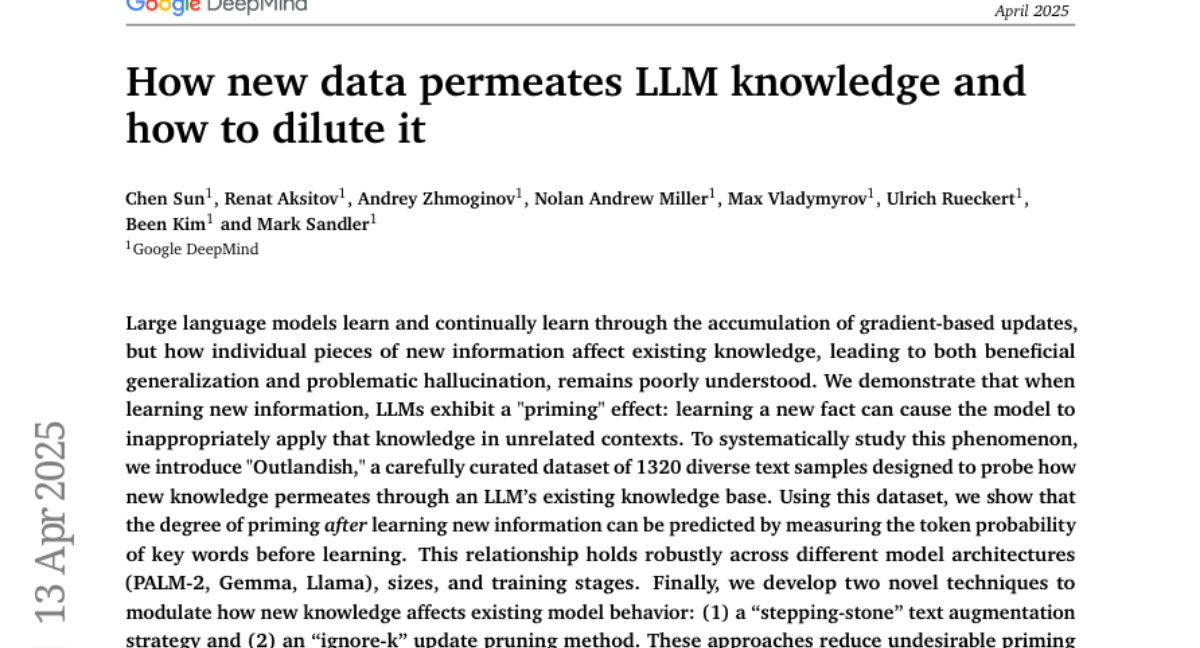
Abstract
LLMs exhibit priming effects when learning new information, which can lead to inappropriate knowledge application; the degree of priming is predictable and modifiable through specific techniques.