Improved Visual-Spatial Reasoning via R1-Zero-Like Training
Zhenyi Liao, Qingsong Xie, Yanhao Zhang, Zijian Kong, Haonan Lu, Zhenyu Yang, Zhijie Deng
2025-04-03
Summary
This paper is about improving how AI models understand and reason about visual information, especially in videos, using a technique similar to how the AI model AlphaZero was trained.
What's the problem?
Small and medium-sized AI models often struggle to understand and reason about visual information, even when given step-by-step instructions.
What's the solution?
The researchers used a special training method, similar to how AlphaZero was trained, to improve the AI models' ability to reason about visual information, especially in videos.
Why it matters?
This work matters because it can lead to AI models that are better at understanding and interacting with the real world, which is important for AI agents and robots.
Abstract
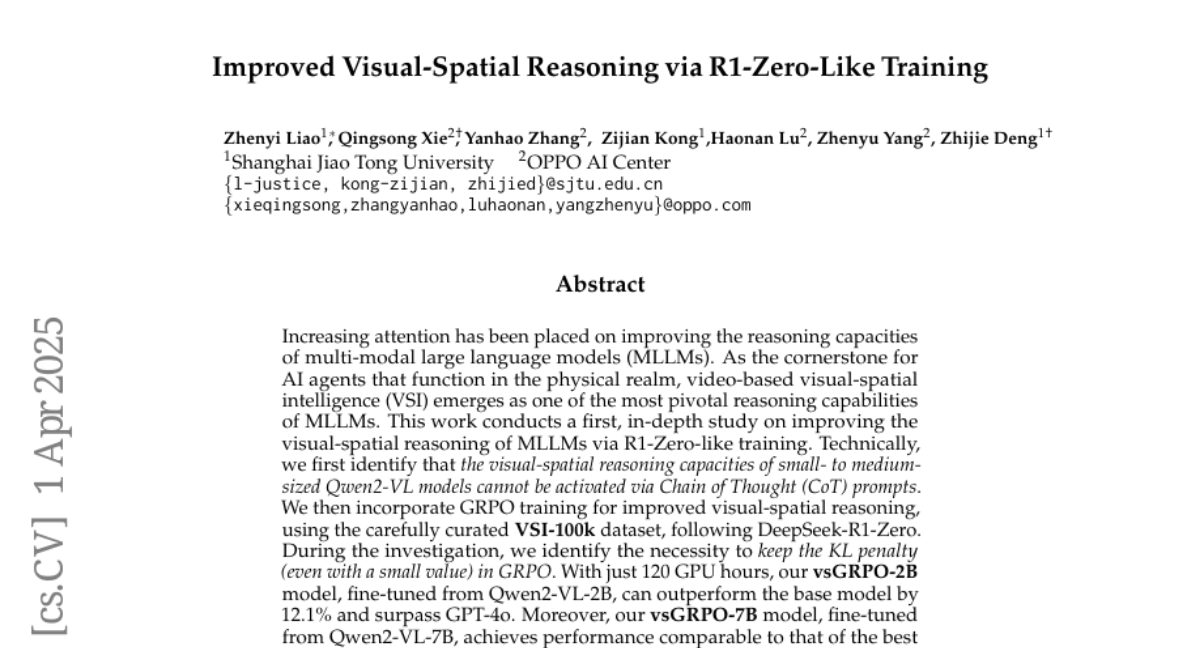
Increasing attention has been placed on improving the reasoning capacities of multi-modal large language models (MLLMs). As the cornerstone for AI agents that function in the physical realm, video-based visual-spatial intelligence (VSI) emerges as one of the most pivotal reasoning capabilities of MLLMs. This work conducts a first, in-depth study on improving the visual-spatial reasoning of MLLMs via R1-Zero-like training. Technically, we first identify that the visual-spatial reasoning capacities of small- to medium-sized Qwen2-VL models cannot be activated via Chain of Thought (CoT) prompts. We then incorporate GRPO training for improved visual-spatial reasoning, using the carefully curated VSI-100k dataset, following DeepSeek-R1-Zero. During the investigation, we identify the necessity to keep the KL penalty (even with a small value) in GRPO. With just 120 GPU hours, our vsGRPO-2B model, fine-tuned from Qwen2-VL-2B, can outperform the base model by 12.1% and surpass GPT-4o. Moreover, our vsGRPO-7B model, fine-tuned from Qwen2-VL-7B, achieves performance comparable to that of the best open-source model LLaVA-NeXT-Video-72B. Additionally, we compare vsGRPO to supervised fine-tuning and direct preference optimization baselines and observe strong performance superiority. The code and dataset will be available soon.