Incorporating brain-inspired mechanisms for multimodal learning in artificial intelligence
Xiang He, Dongcheng Zhao, Yang Li, Qingqun Kong, Xin Yang, Yi Zeng
2025-05-21
Summary
This paper talks about making AI systems smarter by copying how the human brain combines information from different senses, like sight and sound, to learn and understand better.
What's the problem?
AI often struggles to mix different types of information, such as images and audio, in a way that's as efficient and effective as the human brain, which can limit how well these systems work on complex tasks.
What's the solution?
The researchers added a brain-inspired technique called inverse effectiveness to neural networks, helping the AI combine information from multiple sources more efficiently and improving its performance on a variety of tasks.
Why it matters?
This matters because it brings AI a step closer to thinking and learning like humans, making it more powerful and useful for real-world problems that involve lots of different types of information.
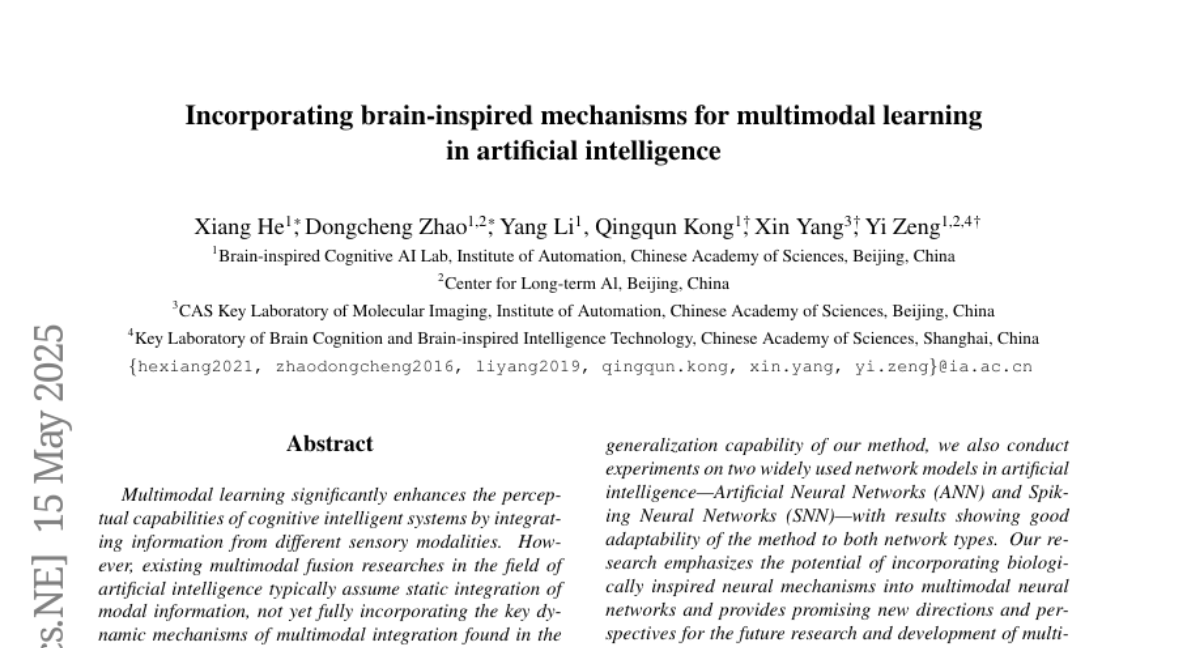
Abstract
Incorporating a biologically inspired inverse effectiveness mechanism into neural networks improves multimodal fusion performance and efficiency across various tasks and network types.