Inference-Time Scaling for Complex Tasks: Where We Stand and What Lies Ahead
Vidhisha Balachandran, Jingya Chen, Lingjiao Chen, Shivam Garg, Neel Joshi, Yash Lara, John Langford, Besmira Nushi, Vibhav Vineet, Yue Wu, Safoora Yousefi
2025-04-02
Summary
This paper investigates how to improve AI models' problem-solving abilities by giving them more time to think during testing.
What's the problem?
It's not clear if giving AI models more time to think helps with all kinds of problems, especially the really hard ones.
What's the solution?
The researchers tested different AI models on various challenging tasks and found that while more thinking time can help, it's not always the answer, and the benefits decrease as the problem gets harder.
Why it matters?
This work matters because it helps us understand the limits of just giving AI more time to think and suggests that we need to find other ways to improve their problem-solving abilities.
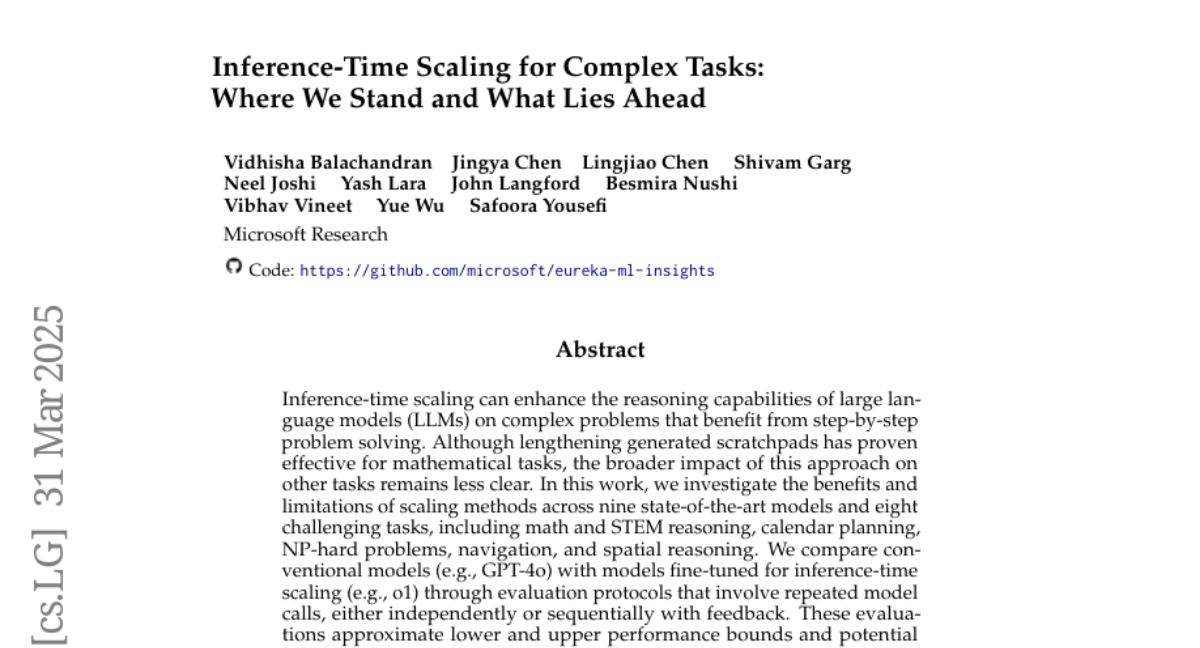
Abstract
Inference-time scaling can enhance the reasoning capabilities of large language models (LLMs) on complex problems that benefit from step-by-step problem solving. Although lengthening generated scratchpads has proven effective for mathematical tasks, the broader impact of this approach on other tasks remains less clear. In this work, we investigate the benefits and limitations of scaling methods across nine state-of-the-art models and eight challenging tasks, including math and STEM reasoning, calendar planning, NP-hard problems, navigation, and spatial reasoning. We compare conventional models (e.g., GPT-4o) with models fine-tuned for inference-time scaling (e.g., o1) through evaluation protocols that involve repeated model calls, either independently or sequentially with feedback. These evaluations approximate lower and upper performance bounds and potential for future performance improvements for each model, whether through enhanced training or multi-model inference systems. Our extensive empirical analysis reveals that the advantages of inference-time scaling vary across tasks and diminish as problem complexity increases. In addition, simply using more tokens does not necessarily translate to higher accuracy in these challenging regimes. Results from multiple independent runs with conventional models using perfect verifiers show that, for some tasks, these models can achieve performance close to the average performance of today's most advanced reasoning models. However, for other tasks, a significant performance gap remains, even in very high scaling regimes. Encouragingly, all models demonstrate significant gains when inference is further scaled with perfect verifiers or strong feedback, suggesting ample potential for future improvements.