Infinity Instruct: Scaling Instruction Selection and Synthesis to Enhance Language Models
Jijie Li, Li Du, Hanyu Zhao, Bo-wen Zhang, Liangdong Wang, Boyan Gao, Guang Liu, Yonghua Lin
2025-06-16
Summary
This paper talks about Infinity Instruct, a large and carefully created collection of instructions that helps improve large language models (LLMs) for both basic understanding and chatting abilities. By mixing and selecting the best instruction data from various sources, Infinity Instruct trains models to perform better across many tasks compared to previous instruction datasets.
What's the problem?
The problem is that existing instruction datasets used to teach language models are often limited in size, variety, or quality, which restricts how well the models can learn to follow instructions and respond accurately in different situations. This can cause the models to be less helpful or flexible, especially when dealing with diverse or complex requests.
What's the solution?
The solution was to build Infinity Instruct by gathering a huge and diverse set of instruction data and then using smart methods to select and combine the best examples. This curated set is used to fine-tune language models to become better at understanding and generating useful, clear, and adaptable responses for a wide range of tasks, improving both their general knowledge and chat skills.
Why it matters?
This matters because better instruction datasets help make language models smarter, more reliable, and easier to interact with for users. By enhancing both foundational knowledge and chatting ability, Infinity Instruct enables AI systems to assist people more effectively in education, work, and daily life, pushing forward the capabilities of AI communication tools.
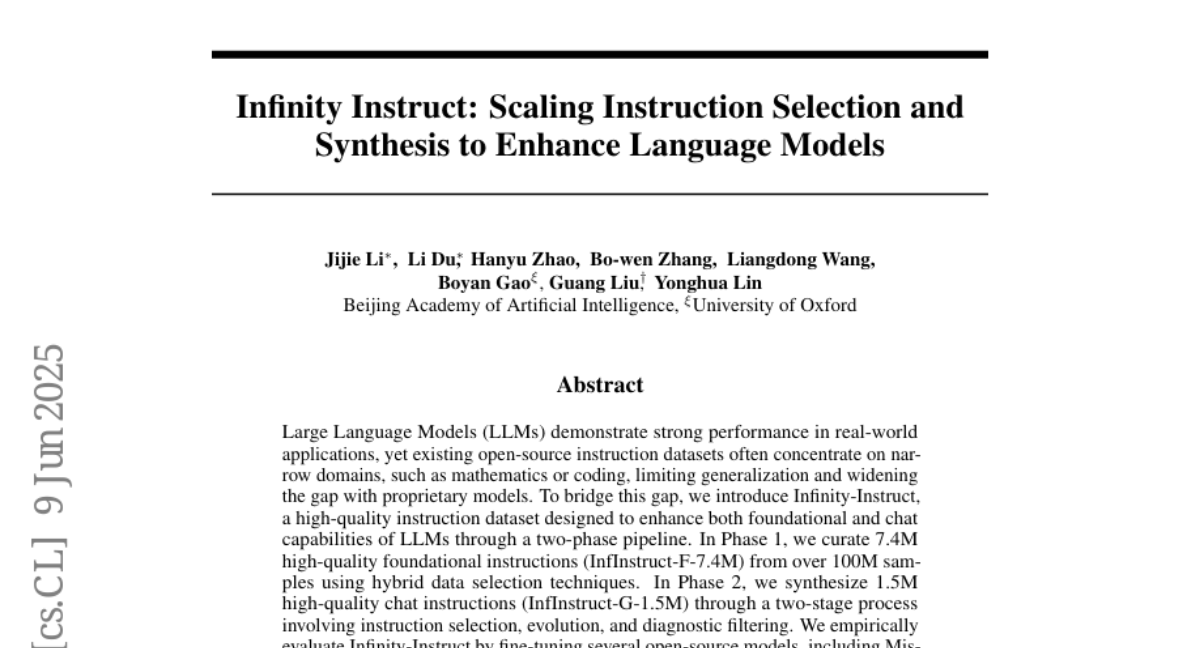
Abstract
Infinity-Instruct, a comprehensive instruction dataset, enhances both foundational and chat capabilities of large language models through curation and synthesis, achieving superior performance compared to existing datasets.