IR3D-Bench: Evaluating Vision-Language Model Scene Understanding as Agentic Inverse Rendering
Parker Liu, Chenxin Li, Zhengxin Li, Yipeng Wu, Wuyang Li, Zhiqin Yang, Zhenyuan Zhang, Yunlong Lin, Sirui Han, Brandon Y. Feng
2025-07-02
Summary
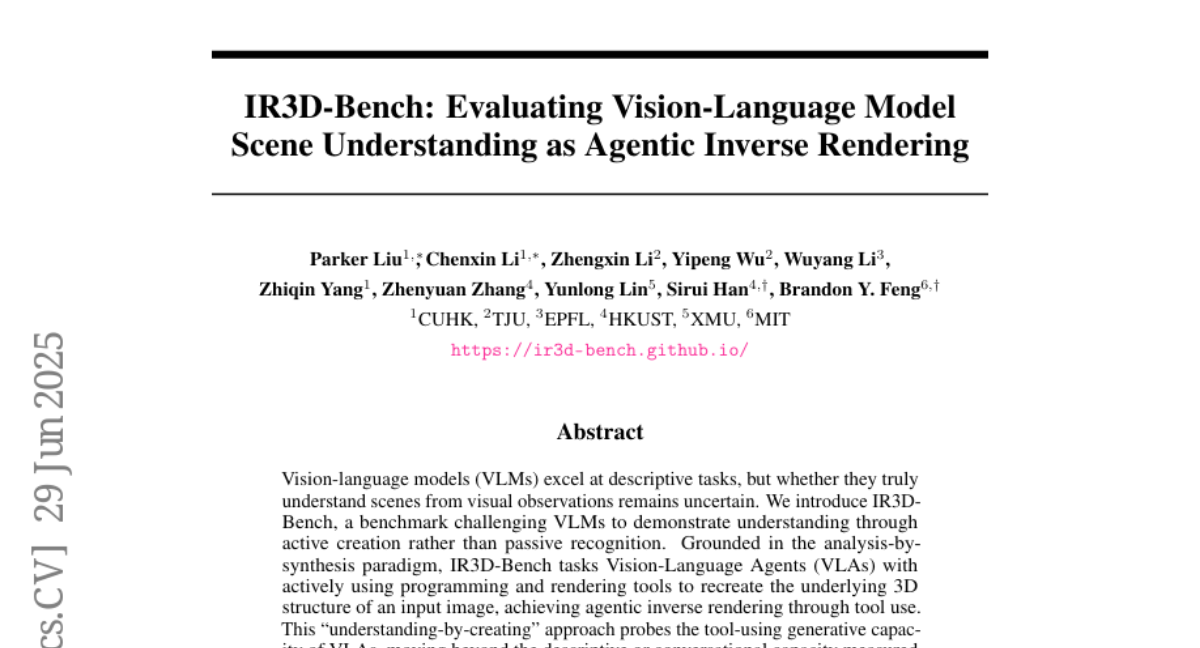
This paper talks about IR3D-Bench, a new way to test how well AI systems that understand both pictures and language can really understand 3D scenes. Instead of just describing what they see, the AI has to recreate the 3D scene using programming and rendering tools.
What's the problem?
The problem is that most AI models are only tested on how well they can recognize or describe images, which doesn’t show if they truly understand the spatial layout and objects in a scene. It’s hard to measure if AI can really grasp the full 3D structure of what it sees.
What's the solution?
The researchers developed IR3D-Bench, which challenges AI to create a detailed 3D model of a scene from a 2D image by generating a program that can rebuild the scene. This gives a clearer metric of how well the AI understands geometry, spatial relationships, appearance, and if the scene looks realistic.
Why it matters?
This matters because it provides a better way to measure AI’s true understanding of visual scenes, which is key for tasks like robotics, virtual reality, and any applications where AI needs to interact with and make sense of the real world.
Abstract
IR3D-Bench evaluates vision-language agents' understanding of scenes by requiring them to recreate 3D structures using programming and rendering tools, providing metrics for geometric accuracy, spatial relations, appearance attributes, and plausibility.