It's All Connected: A Journey Through Test-Time Memorization, Attentional Bias, Retention, and Online Optimization
Ali Behrouz, Meisam Razaviyayn, Peilin Zhong, Vahab Mirrokni
2025-04-21
Summary
This paper talks about Miras, a new framework for building deep learning models that uses ideas from how memory and attention work in the brain to create smarter and more efficient AI systems.
What's the problem?
The problem is that current deep learning models, like Transformers, can be really good at some tasks but often struggle to remember information over long periods or handle complicated patterns in data. There hasn’t been a clear way to design these models so they can balance memory, attention, and learning in the best possible way.
What's the solution?
The researchers introduced Miras, which brings together different memory and attention strategies into one system. They treat models as if they have associative memory, meaning they can link related pieces of information together, and use new ways to control what the model pays attention to and what it remembers. This lets them design new models that are better at tasks like language modeling and recalling long sequences, and also makes training these models faster and more efficient.
Why it matters?
This matters because it gives AI researchers a better blueprint for creating future models that can handle more complex tasks, remember important details longer, and work more efficiently, which could lead to big improvements in things like language understanding, search engines, and even personal assistants.
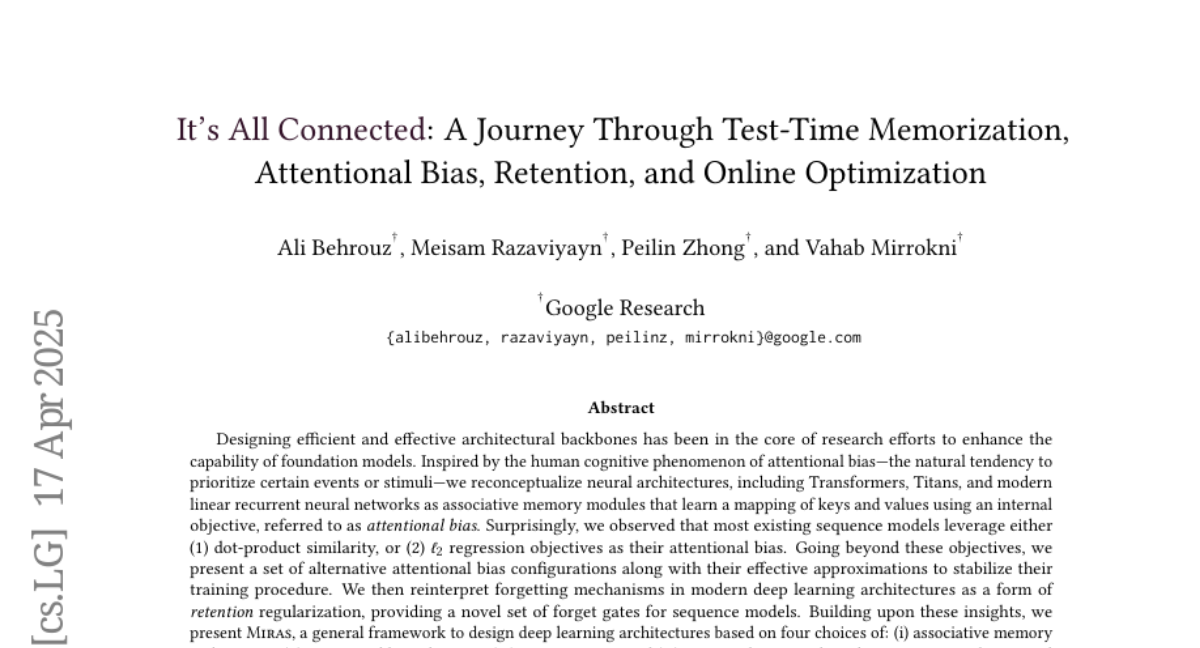
Abstract
A novel framework, Miras, introduces associative memory and new attentional bias mechanisms to design deep learning architectures capable of exceptional performance in various tasks.