"It's not a representation of me": Examining Accent Bias and Digital Exclusion in Synthetic AI Voice Services
Shira Michel, Sufi Kaur, Sarah Elizabeth Gillespie, Jeffrey Gleason, Christo Wilson, Avijit Ghosh
2025-04-17
Summary
This paper talks about how AI voice services, like those that read text out loud or clone voices, often work better for some accents than others, which can leave people with less common accents feeling left out or misrepresented.
What's the problem?
The problem is that most AI voice systems are trained mainly on American and British accents, so they don't always sound accurate or natural when trying to represent other regional or cultural accents. This not only makes the technology less useful for people with underrepresented accents, but it can also make them feel excluded or like the technology isn't really for them. It can even reinforce existing social biases, giving more privilege to people who speak with the most common or 'standard' accents while making it harder for others to access digital services comfortably.
What's the solution?
The researchers evaluated two popular AI voice platforms by testing how well they worked with five different English accents and by talking to users about their experiences. They found clear differences in how these systems performed across accents and discovered that just having an accurate accent isn't enough—people also care about how the voice feels emotionally and culturally. The study suggests that making AI voices more inclusive requires both technical improvements and thoughtful design that considers the real experiences and needs of diverse users.
Why it matters?
This matters because as AI voice technology becomes a bigger part of daily life, it's important that everyone can use it and feel represented, no matter how they speak. Making these systems fairer and more inclusive helps prevent digital exclusion and ensures that technology serves all communities equally, not just those with the most common accents.
Abstract
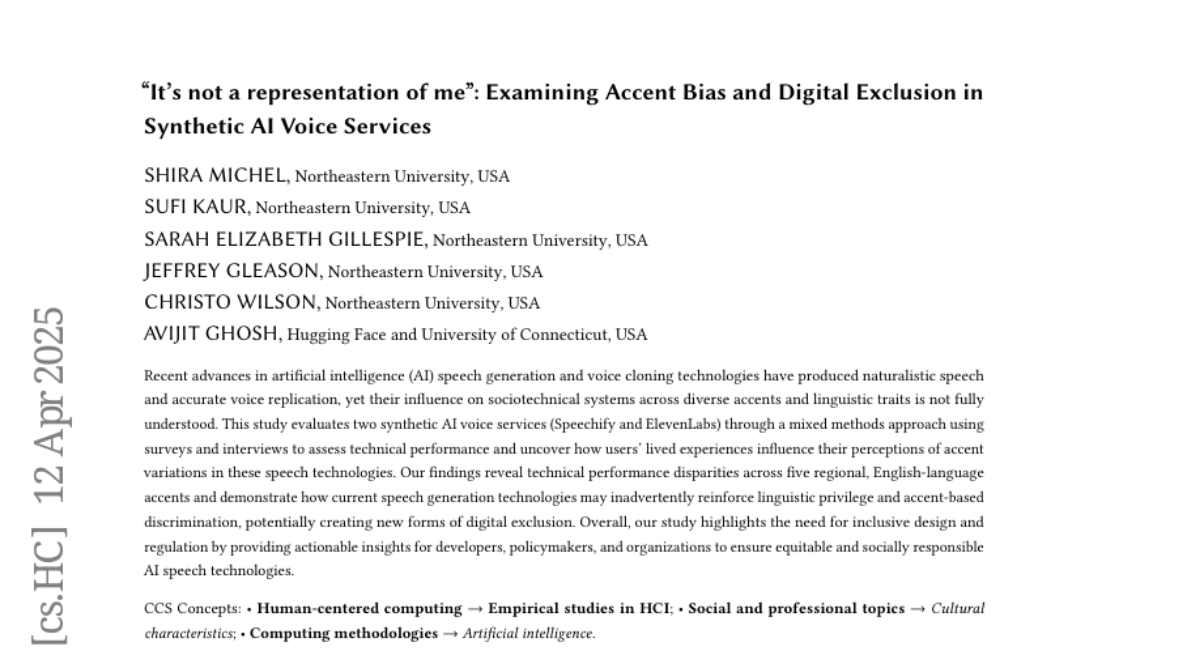
Evaluation of AI speech services shows performance disparities across accents, possibly reinforcing linguistic privilege and digital exclusion, emphasizing the need for inclusive design and regulation.