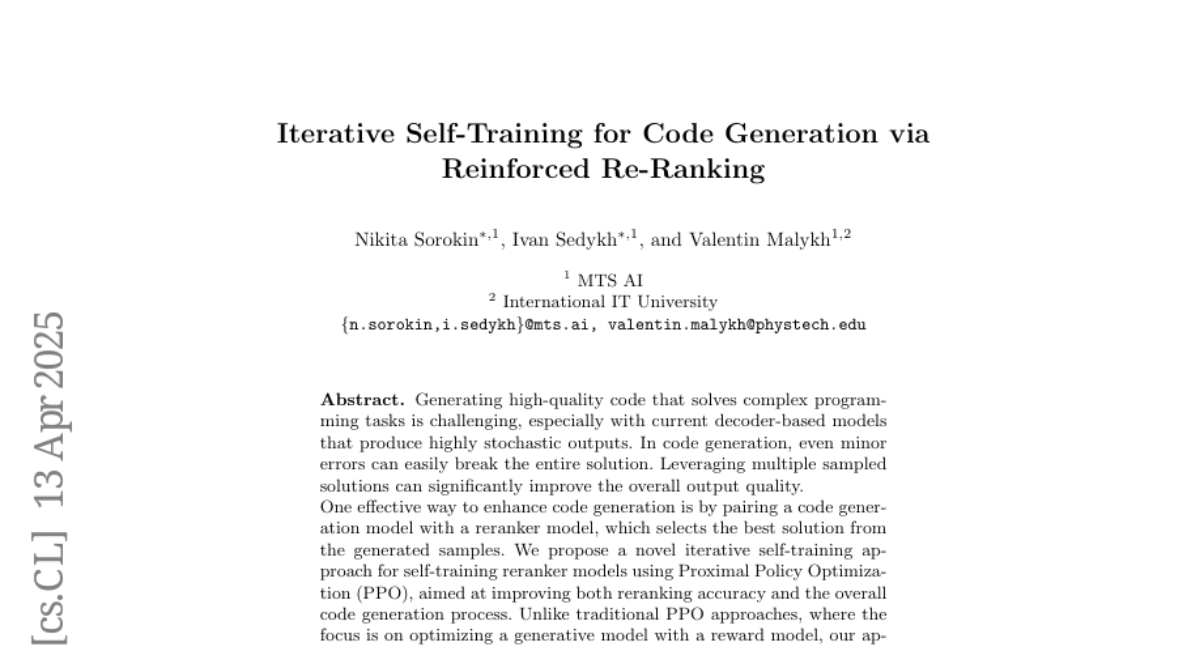
Iterative Self-Training for Code Generation via Reinforced Re-Ranking
Nikita Sorokin, Ivan Sedykh, Valentin Malykh
2025-04-15
Summary
This paper talks about a new way to help AI models get better at writing computer code by teaching them to pick the best code solutions through a process of self-improvement and feedback. The method uses a special training technique to make the AI smarter at choosing the most accurate and high-quality code.
What's the problem?
The problem is that even though AI models can generate code, they often make mistakes or don't always pick the best solution out of several options. Bigger models can sometimes do better, but they use more resources and aren't always practical for everyone to use.
What's the solution?
The researchers introduced an iterative self-training method where the AI keeps learning from its own attempts at code generation. They use a technique called Proximal Policy Optimization to help the model improve at ranking and selecting the best code each time. This makes the AI's choices more accurate and reliable, even when compared to much larger models.
Why it matters?
This work matters because it shows how smaller, more efficient AI models can be trained to write better code, making advanced coding tools available to more people. This could help students, programmers, and companies get smarter coding help without needing massive computing power.
Abstract
An iterative self-training approach using Proximal Policy Optimization enhances reranker models for code generation, improving accuracy and quality compared to larger models.