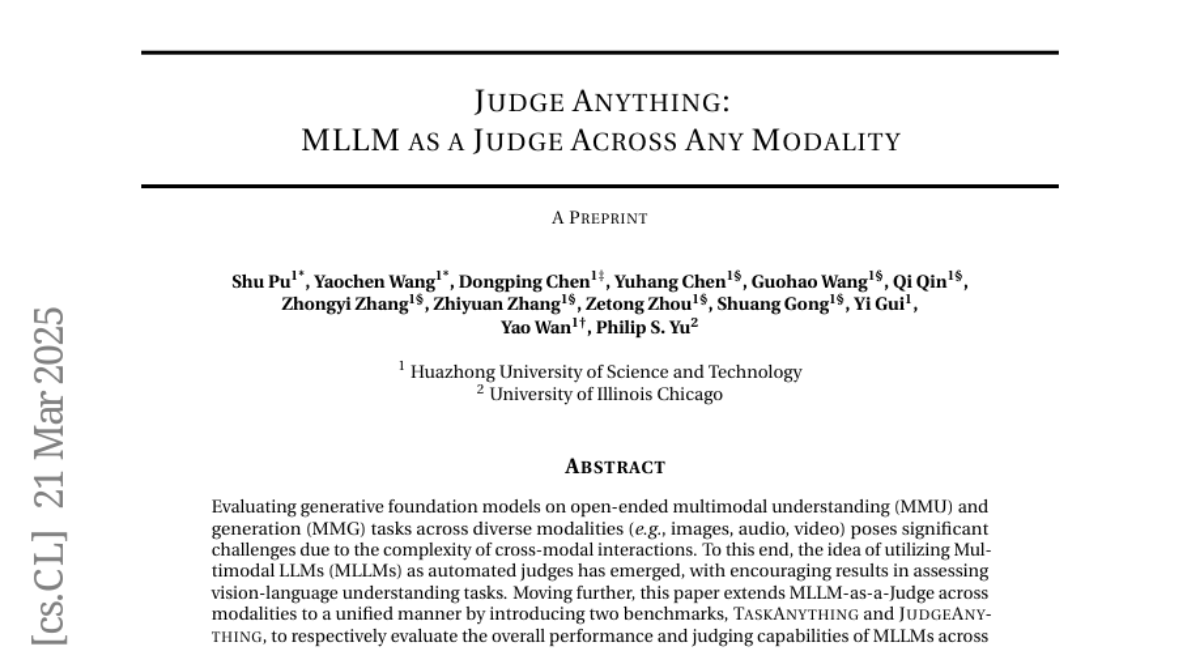
Judge Anything: MLLM as a Judge Across Any Modality
Shu Pu, Yaochen Wang, Dongping Chen, Yuhang Chen, Guohao Wang, Qi Qin, Zhongyi Zhang, Zhiyuan Zhang, Zetong Zhou, Shuang Gong, Yi Gui, Yao Wan, Philip S. Yu
2025-03-25
Summary
This paper explores how well AI can judge the quality of AI-generated content across different types of media, like images, audio, and video.
What's the problem?
It's difficult to evaluate how good AI-generated content is, especially when dealing with different types of media that interact with each other. We need a way to reliably assess if the AI is doing a good job.
What's the solution?
The researchers created two new tests, TaskAnything and JudgeAnything, to evaluate both the AI's ability to create content and its ability to judge the quality of content created by other AI, across different media types. They also developed a platform called OmniArena to help with this evaluation.
Why it matters?
This work matters because it helps us understand the strengths and weaknesses of AI in creating and understanding different types of media. It also provides tools to improve AI evaluation and ensure it aligns with human preferences.
Abstract
Evaluating generative foundation models on open-ended multimodal understanding (MMU) and generation (MMG) tasks across diverse modalities (e.g., images, audio, video) poses significant challenges due to the complexity of cross-modal interactions. To this end, the idea of utilizing Multimodal LLMs (MLLMs) as automated judges has emerged, with encouraging results in assessing vision-language understanding tasks. Moving further, this paper extends MLLM-as-a-Judge across modalities to a unified manner by introducing two benchmarks, TaskAnything and JudgeAnything, to respectively evaluate the overall performance and judging capabilities of MLLMs across any-to-any modality tasks. Specifically, TaskAnything evaluates the MMU and MMG capabilities across 15 any-to-any modality categories, employing 1,500 queries curated from well-established benchmarks. Furthermore, JudgeAnything evaluates the judging capabilities of 5 advanced (e.g., GPT-4o and Gemini-2.0-Flash) from the perspectives of Pair Comparison and Score Evaluation, providing a standardized testbed that incorporates human judgments and detailed rubrics. Our extensive experiments reveal that while these MLLMs show promise in assessing MMU (i.e., achieving an average of 66.55% in Pair Comparison setting and 42.79% in Score Evaluation setting), they encounter significant challenges with MMG tasks (i.e., averaging only 53.37% in Pair Comparison setting and 30.05% in Score Evaluation setting), exposing cross-modality biases and hallucination issues. To address this, we present OmniArena, an automated platform for evaluating omni-models and multimodal reward models. Our work highlights the need for fairer evaluation protocols and stronger alignment with human preferences. The source code and dataset are publicly available at: https://urrealhero.github.io/judgeanythingweb/.