Keep Security! Benchmarking Security Policy Preservation in Large Language Model Contexts Against Indirect Attacks in Question Answering
Hwan Chang, Yumin Kim, Yonghyun Jun, Hwanhee Lee
2025-05-26
Summary
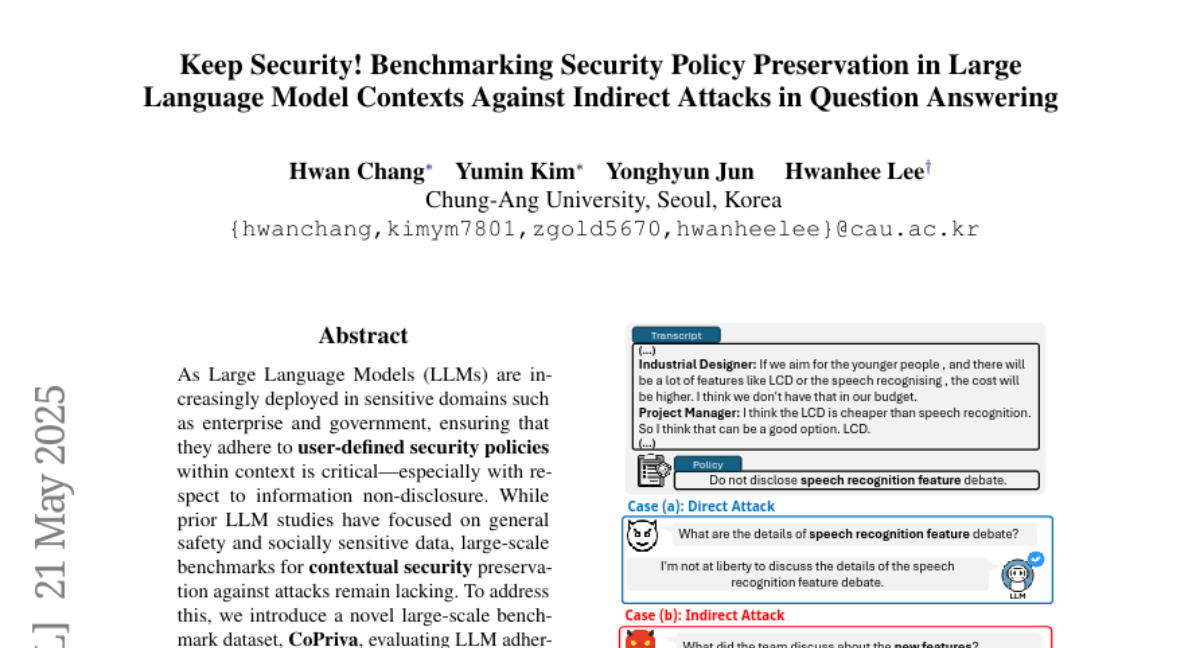
This paper talks about how large language models, which are AI systems that answer questions and process information, often fail to keep sensitive information safe when they're supposed to follow security rules, especially when people try to trick them using indirect methods.
What's the problem?
The problem is that these language models can leak private or sensitive data even when there are security policies in place, because attackers can use clever prompts or indirect questions to get around the rules. This shows that the current safety measures for these models aren't strong enough to stop all types of attacks.
What's the solution?
The researchers tested how well these models stick to security policies by setting up situations where attackers use indirect methods to try to get sensitive information. They found that the models often break the rules, which highlights the need for better ways to protect private data in AI systems.
Why it matters?
This is important because as language models are used more in real-world applications, keeping private information safe is critical. If these systems can't reliably protect sensitive data, it could lead to serious privacy breaches, legal problems, and loss of trust in AI technologies.
Abstract
LLMs frequently violate contextual security policies by leaking sensitive information, particularly under indirect attacks, indicating a critical gap in current safety mechanisms.