Large Language Model Agent: A Survey on Methodology, Applications and Challenges
Junyu Luo, Weizhi Zhang, Ye Yuan, Yusheng Zhao, Junwei Yang, Yiyang Gu, Bohan Wu, Binqi Chen, Ziyue Qiao, Qingqing Long, Rongcheng Tu, Xiao Luo, Wei Ju, Zhiping Xiao, Yifan Wang, Meng Xiao, Chenwu Liu, Jingyang Yuan, Shichang Zhang, Yiqiao Jin, Fan Zhang, Xian Wu
2025-03-28
Summary
This paper is a review of the current state of AI agents powered by large language models, exploring how they work, what they can do, and what challenges they face.
What's the problem?
The field of LLM agents is rapidly growing, but research is scattered and it's difficult to get a clear overview of the key concepts and challenges.
What's the solution?
This survey provides a structured framework for understanding LLM agents, covering their architecture, collaboration mechanisms, and how they evolve, as well as addressing evaluation methods and applications.
Why it matters?
This work matters because it helps researchers understand the current state of LLM agents and identifies promising directions for future research, potentially leading to more advanced and capable AI systems.
Abstract
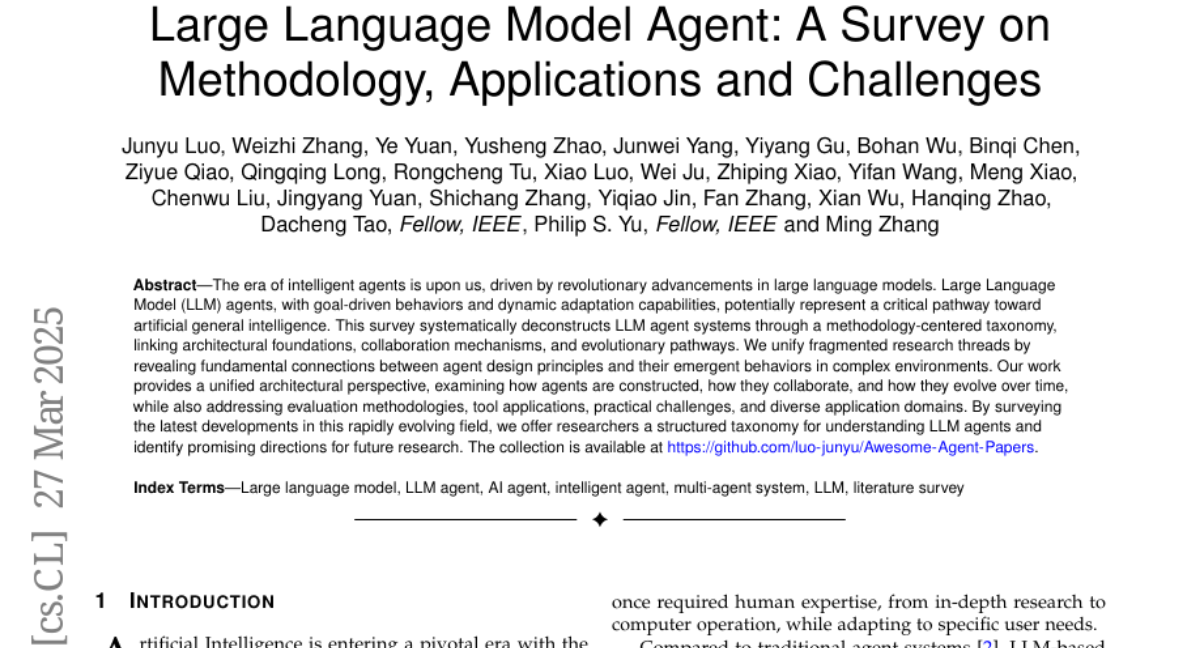
The era of intelligent agents is upon us, driven by revolutionary advancements in large language models. Large Language Model (LLM) agents, with goal-driven behaviors and dynamic adaptation capabilities, potentially represent a critical pathway toward artificial general intelligence. This survey systematically deconstructs LLM agent systems through a methodology-centered taxonomy, linking architectural foundations, collaboration mechanisms, and evolutionary pathways. We unify fragmented research threads by revealing fundamental connections between agent design principles and their emergent behaviors in complex environments. Our work provides a unified architectural perspective, examining how agents are constructed, how they collaborate, and how they evolve over time, while also addressing evaluation methodologies, tool applications, practical challenges, and diverse application domains. By surveying the latest developments in this rapidly evolving field, we offer researchers a structured taxonomy for understanding LLM agents and identify promising directions for future research. The collection is available at https://github.com/luo-junyu/Awesome-Agent-Papers.