Latent Diffusion Autoencoders: Toward Efficient and Meaningful Unsupervised Representation Learning in Medical Imaging
Gabriele Lozupone, Alessandro Bria, Francesco Fontanella, Frederick J. A. Meijer, Claudio De Stefano, Henkjan Huisman
2025-04-14
Summary
This paper talks about Latent Diffusion Autoencoders (LDAE), a new method for teaching AI to learn from and generate 3D medical images, like MRI scans, without needing labeled data. The focus is on making this process much faster and more efficient, especially for studying diseases like Alzheimer's.
What's the problem?
The problem is that analyzing and generating 3D medical images usually takes a lot of computer power and time, especially when trying to learn useful features without any labels. Traditional methods work directly on the full images, which makes them slow and hard to use for big medical datasets or for tracking changes in diseases over time.
What's the solution?
The researchers created LDAE, which first compresses the huge MRI scans into a smaller, more manageable form called a latent space. Then, the AI uses a special diffusion process in this compressed space to learn patterns and generate new images. This makes everything run much faster and still allows the model to pick up on important medical details, like signs of Alzheimer's or aging. The model can also fill in missing scans and even change certain features in the images in a realistic way.
Why it matters?
This work matters because it makes it possible to train powerful AI models for medical imaging much more efficiently, without needing tons of labeled data. This could help doctors diagnose diseases earlier, track how illnesses progress, and improve research by making it easier to analyze large sets of 3D medical images.
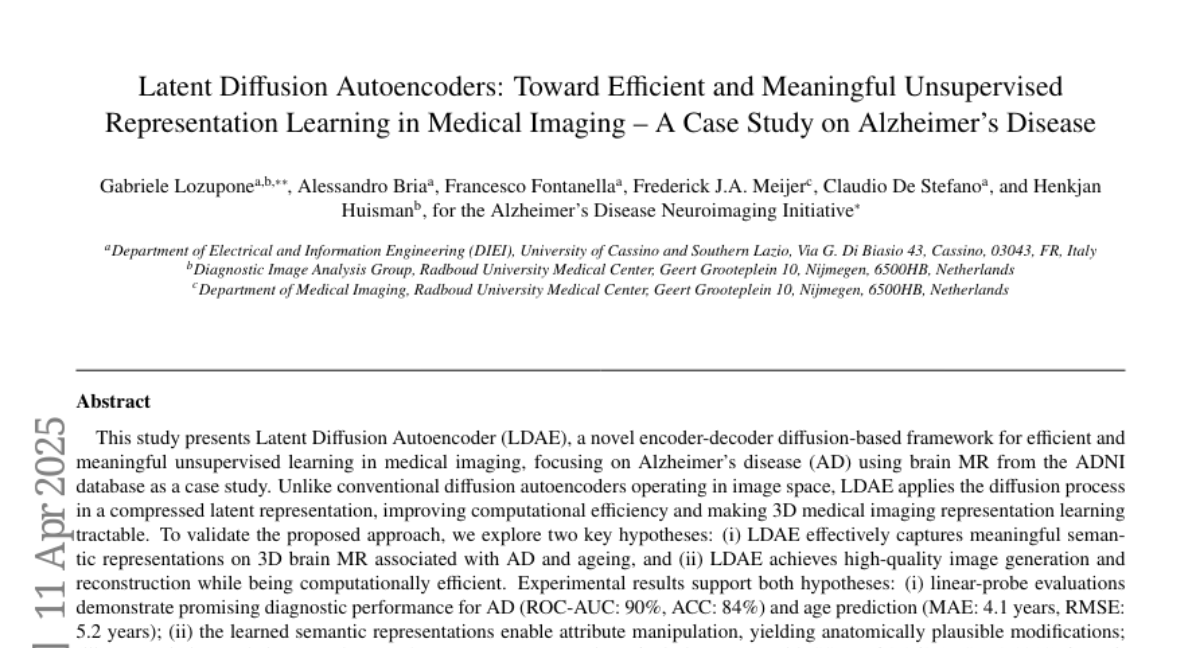
Abstract
Latent Diffusion Autoencoder (LDAE) achieves efficient and high-quality unsupervised learning and image generation in medical imaging, particularly for Alzheimer's disease, by operating in a compressed latent space and demonstrating superior performance over conventional diffusion autoencoders.