Learning Adaptive Parallel Reasoning with Language Models
Jiayi Pan, Xiuyu Li, Long Lian, Charlie Snell, Yifei Zhou, Adam Yala, Trevor Darrell, Kurt Keutzer, Alane Suhr
2025-04-23
Summary
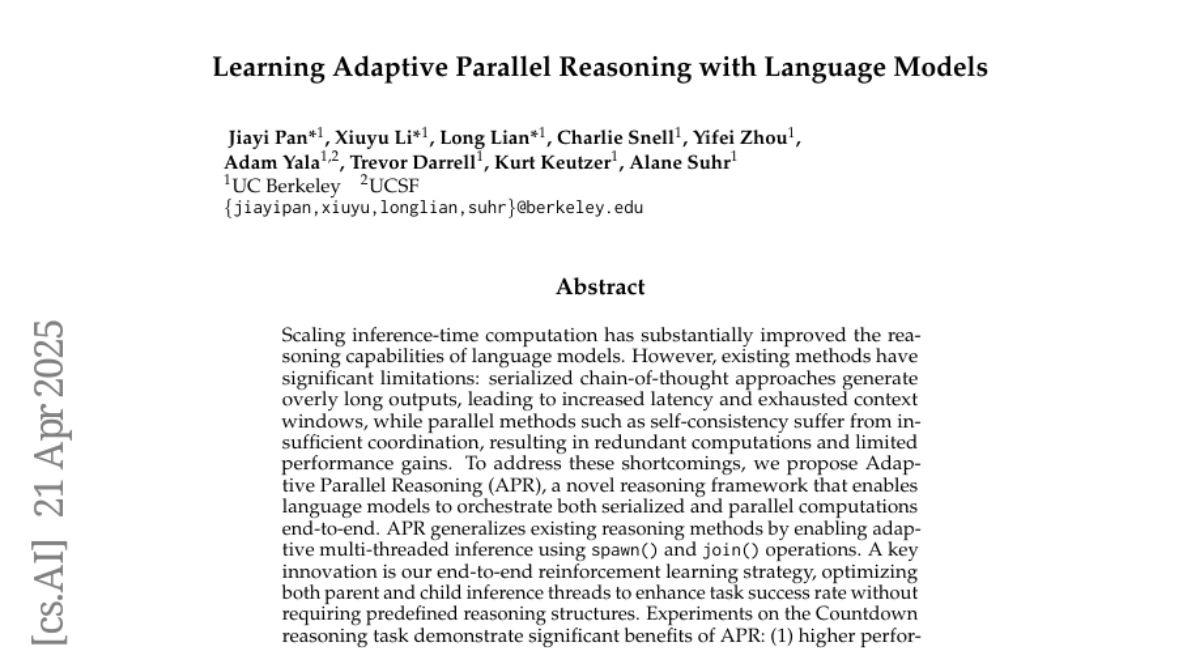
This paper talks about a new method called Adaptive Parallel Reasoning, or APR, which helps language models solve problems faster and more accurately by figuring out the best way to split up and combine different parts of a problem.
What's the problem?
The problem is that language models usually process information in a set order or all at once, but not every problem is best solved that way. Sometimes, doing things step-by-step is too slow, and doing everything at once can lead to mistakes or confusion, especially with complicated tasks.
What's the solution?
The researchers developed APR, which uses adaptive multi-threading and reinforcement learning to let the model decide when to work on things in order and when to do them in parallel. This makes the model more flexible, so it can handle different types of problems more efficiently.
Why it matters?
This matters because it means language models can become smarter and faster at solving a wider variety of problems, making them even more helpful for tasks like answering questions, planning, or analyzing information.
Abstract
Adaptive Parallel Reasoning (APR) enhances language model performance by optimally combining serialized and parallel computations through adaptive multi-threading and reinforcement learning.