Learning Dense Hand Contact Estimation from Imbalanced Data
Daniel Sungho Jung, Kyoung Mu Lee
2025-05-19
Summary
This paper talks about a new way to teach computers how to figure out exactly where a hand touches an object, even when the training data isn't balanced.
What's the problem?
The problem is that when computers try to learn where hands make contact with objects, the examples they get for training are often uneven. Some types of contact or places on the hand have way more examples than others, which makes it hard for the computer to learn about the rare cases.
What's the solution?
To fix this, the researchers created a system that carefully chooses more balanced examples for training and uses a special method that makes the computer pay more attention to the less common types of hand contact. This helps the computer learn from both the common and rare cases equally well.
Why it matters?
This is important because being able to accurately predict where hands touch objects can help with things like robotics, virtual reality, and understanding how people interact with the world, especially when the data available isn't perfect.
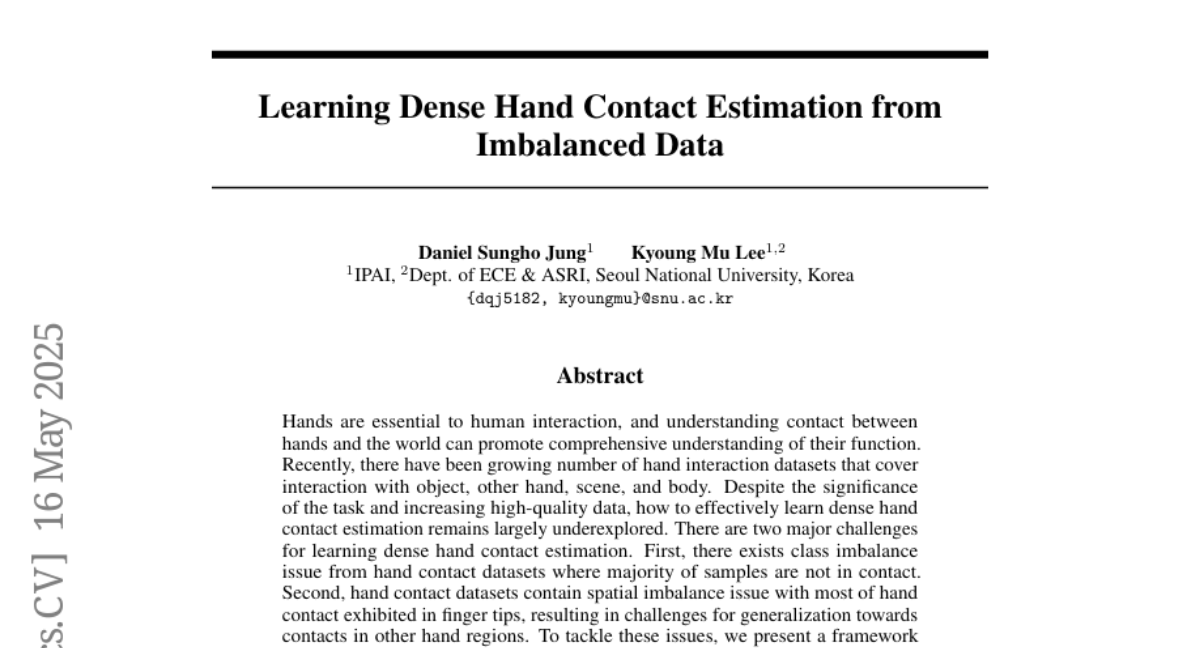
Abstract
A framework addresses dense hand contact estimation from imbalanced datasets using balanced contact sampling and a vertex-level class-balanced loss to handle class and spatial imbalance issues.