Learning to Skip the Middle Layers of Transformers
Tim Lawson, Laurence Aitchison
2025-06-27
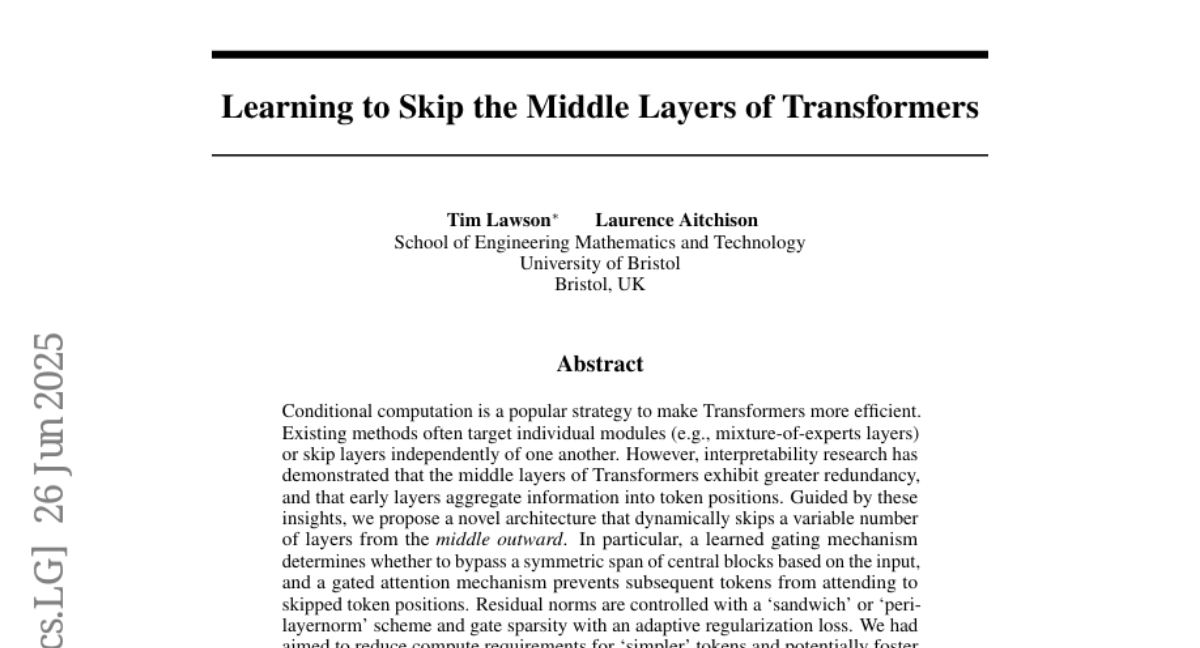
Summary
This paper talks about a new way to make Transformer AI models more efficient by skipping some of the middle layers during processing, based on the idea that those layers are often repetitive or redundant.
What's the problem?
The problem is that Transformers waste a lot of computing power processing all layers equally, even when some parts, especially the middle layers, don’t add much new information, which makes the models slower and more expensive to run.
What's the solution?
The researchers developed a gating mechanism that learns when to skip a symmetric group of middle layers depending on the input, allowing simpler inputs to bypass unnecessary computing steps, and they also adjusted the attention system so that tokens don't pay attention to skipped parts, aiming to save computing resources while keeping performance.
Why it matters?
This matters because if AI models can skip unnecessary work dynamically, they could run faster and use less energy, which is important for making AI cheaper and more accessible, even though this specific method didn’t yet outperform simpler smaller models in early tests.
Abstract
A novel conditional computation architecture for Transformers dynamically skips middle layers based on input and a gating mechanism, but does not outperform dense baselines in reducing computational cost or improving validation performance.