LETS Forecast: Learning Embedology for Time Series Forecasting
Abrar Majeedi, Viswanatha Reddy Gajjala, Satya Sai Srinath Namburi GNVV, Nada Magdi Elkordi, Yin Li
2025-06-17
Summary
This paper talks about LETS Forecast, a new method for predicting future values in time series data, which is data collected over time like weather or stock prices. The method, called DeepEDM, combines traditional ideas from a field called empirical dynamic modeling with modern deep learning techniques. It learns hidden patterns and dynamics in the data by looking at multiple past time points together, then uses a smart regression process to predict what will happen next more accurately.
What's the problem?
The problem is that many existing deep learning approaches for time series forecasting just look for patterns in the observed data without really understanding the hidden complex systems that generate these patterns. This makes predictions less reliable, especially when the data is noisy or the system behaves in a complicated, nonlinear way.
What's the solution?
The solution was to create DeepEDM, which learns a representation of the data in a latent space using time-delayed embeddings inspired by empirical dynamic modeling and Takens' theorem. It then applies kernel regression on this learned space to approximate the underlying dynamics and predict future time steps. This approach integrates classic dynamical system theory with deep neural networks and attention mechanisms for better forecasting accuracy.
Why it matters?
This matters because having more accurate and reliable time series forecasts can improve decision-making in many fields like finance, weather prediction, traffic management, and more. By understanding the complex hidden dynamics rather than just surface patterns, DeepEDM can make smarter predictions even with noisy data, helping industries and researchers better anticipate future events.
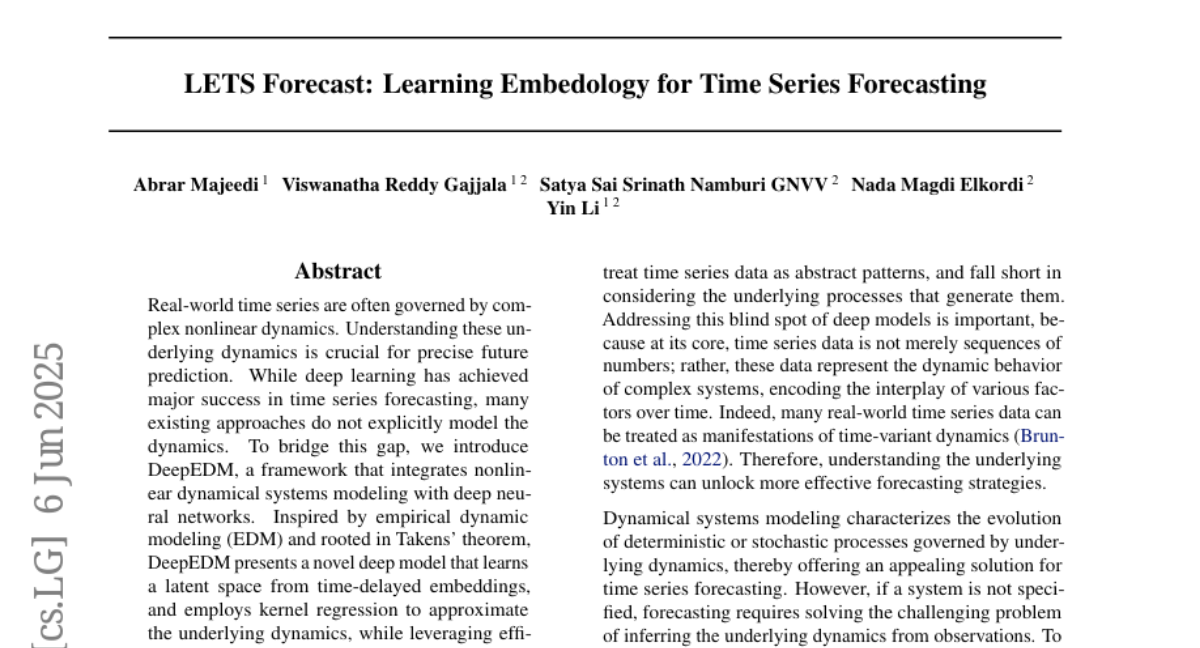
Abstract
DeepEDM integrates empirical dynamic modeling with deep neural networks to learn latent spaces and approximate complex nonlinear dynamics for improved time series forecasting.