Light of Normals: Unified Feature Representation for Universal Photometric Stereo
Hong Li, Houyuan Chen, Chongjie Ye, Zhaoxi Chen, Bohan Li, Shaocong Xu, Xianda Guo, Xuhui Liu, Yikai Wang, Baochang Zhang, Satoshi Ikehata, Boxin Shi, Anyi Rao, Hao Zhao
2025-06-24
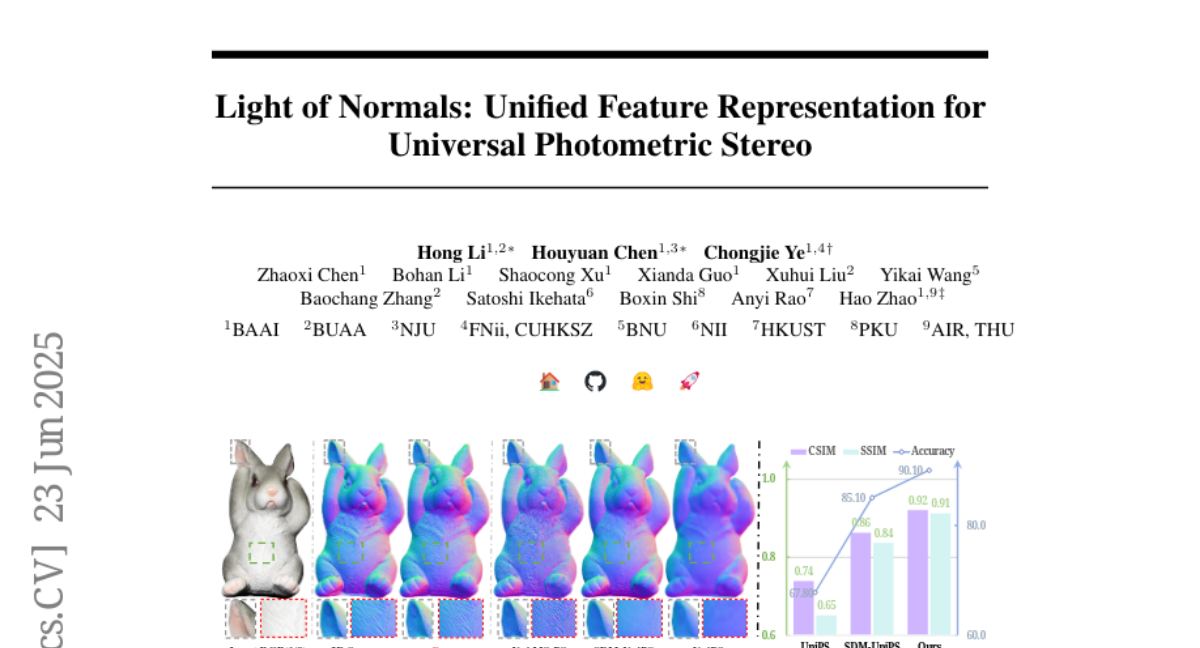
Summary
This paper talks about Light of Normals, a new approach to photometric stereo, which is a computer vision technique for figuring out the exact shape details of objects by looking at how light shines on them from different directions.
What's the problem?
The problem is that it's difficult to separate how light affects what we see from the actual shape of the surface, especially when trying to keep fine details and under different lighting conditions.
What's the solution?
The researchers introduced a unified way to represent features that helps the model better understand and recover the surface normals of objects, even under tricky lighting, preserving detailed surface shapes more accurately.
Why it matters?
This matters because accurately capturing object surfaces helps in many fields like graphics, robotics, and medical imaging, making computers see and understand 3D shapes better and faster.
Abstract
Photometric stereo aims to recover high-quality surface normals under arbitrary lighting conditions, addressing challenges related to illumination-surface normal coupling and high-frequency geometric detail preservation.