LLMalMorph: On The Feasibility of Generating Variant Malware using Large-Language-Models
Md Ajwad Akil, Adrian Shuai Li, Imtiaz Karim, Arun Iyengar, Ashish Kundu, Vinny Parla, Elisa Bertino
2025-07-16
Summary
This paper talks about LLMalMorph, a system that uses large language models to create new versions of malware by understanding and changing the original malware source code.
What's the problem?
The problem is that malware creators want to make new malware variants that avoid detection by antivirus and machine learning tools, but manually creating such variants is hard and time-consuming.
What's the solution?
LLMalMorph solves this by automatically extracting pieces of malware code, using large language models to modify these pieces while keeping the malware’s functionality, and then putting them back together. This semi-automated approach doesn’t need extra training and can generate many new malware variants that are harder for security systems to detect.
Why it matters?
This matters because it shows how advanced AI tools can be used by attackers to create more dangerous and harder-to-catch malware, which means cybersecurity needs to improve and adapt to defend against these evolving threats.
Abstract
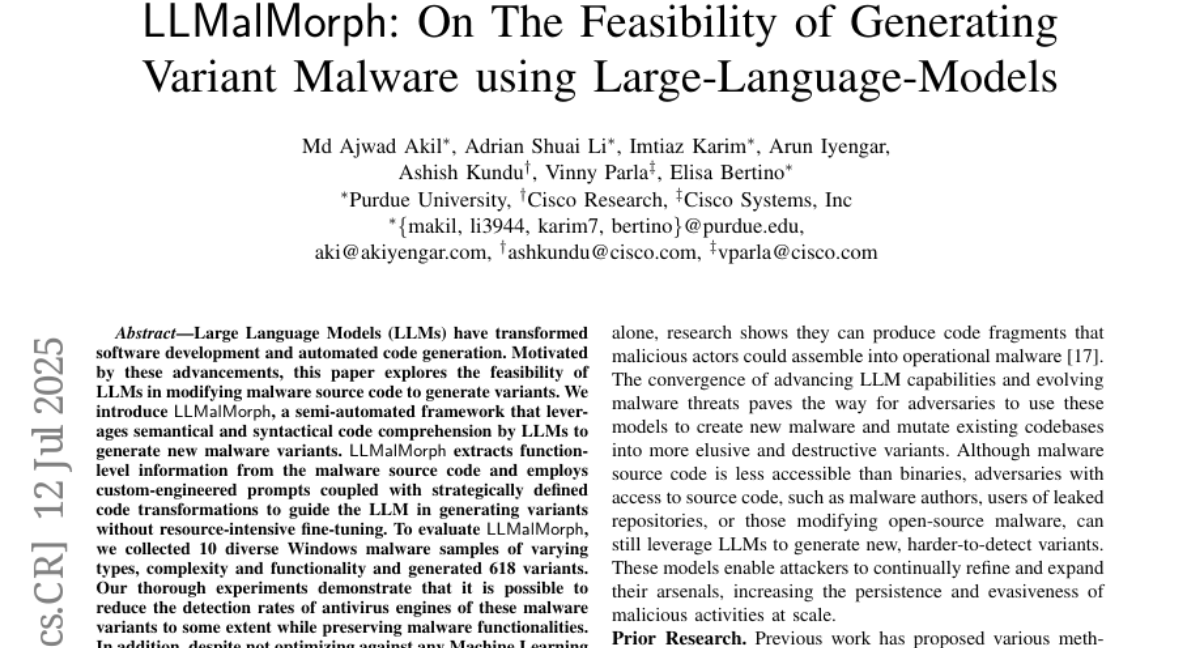
LLMalMorph, a semi-automated framework using LLMs, generates malware variants by semantically and syntactically comprehending source code, reducing detection rates and achieving attack success against ML-based classifiers.