LLMs are Greedy Agents: Effects of RL Fine-tuning on Decision-Making Abilities
Thomas Schmied, Jörg Bornschein, Jordi Grau-Moya, Markus Wulfmeier, Razvan Pascanu
2025-04-23
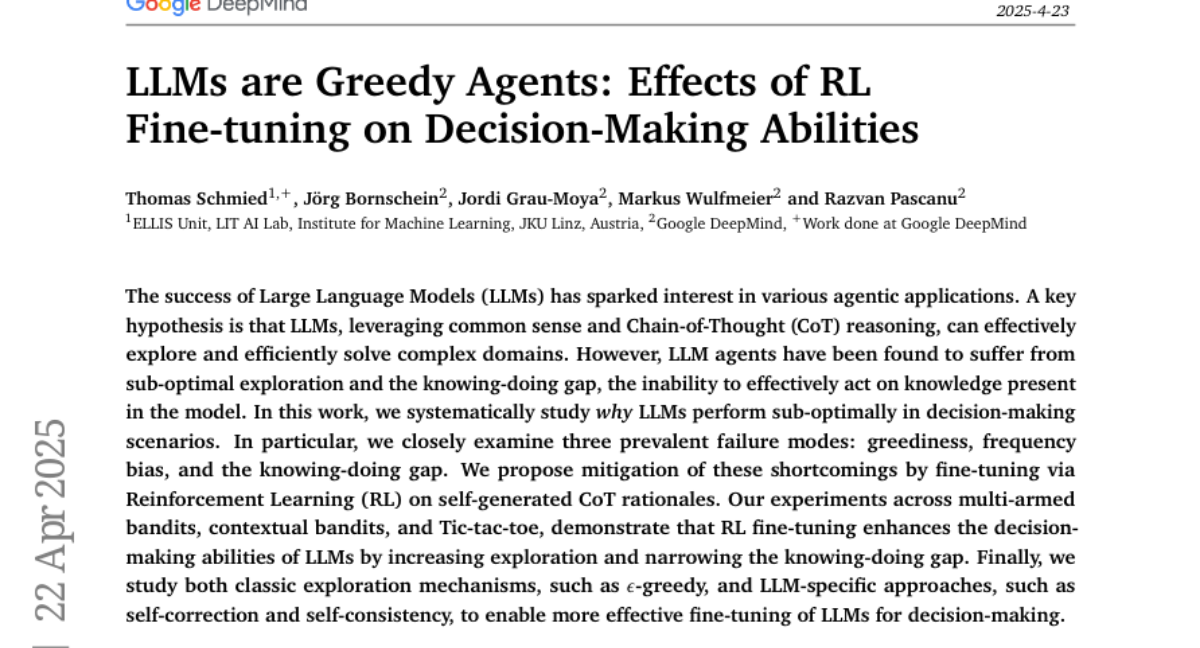
Summary
This paper talks about how large language models (LLMs) can make better decisions if they're trained not just to go for the most obvious answer, but to actually think through their reasoning step by step using special training methods.
What's the problem?
The problem is that LLMs often act 'greedy,' meaning they quickly pick answers that seem right without really thinking them through. This can lead to mistakes, bias toward common answers, or a gap between what the model knows and what it actually does when making decisions.
What's the solution?
The researchers used reinforcement learning and a technique called Chain-of-Thought prompting, which trains the model to explain its reasoning in steps before giving a final answer. This helps the model slow down, consider different possibilities, and make more logical decisions instead of just jumping to conclusions.
Why it matters?
This matters because it makes AI more reliable and trustworthy, especially for complicated problems where careful thinking and clear explanations are important, like in education, science, or any situation where you need to understand not just the answer, but how the answer was reached.
Abstract
Reinforcement learning fine-tuning with Chain-of-Thought rationales enhances Large Language Models' decision-making abilities by addressing greediness, frequency bias, and the knowing-doing gap.