Lost in Latent Space: An Empirical Study of Latent Diffusion Models for Physics Emulation
François Rozet, Ruben Ohana, Michael McCabe, Gilles Louppe, François Lanusse, Shirley Ho
2025-07-07
Summary
This paper talks about how latent diffusion models can be used to simulate physical systems in a way that balances speed and accuracy. Instead of working directly with detailed pixel data, these models use compressed representations called latent spaces, making simulations much faster while still accurate.
What's the problem?
The problem is that traditional diffusion models for physics simulations are very slow because they operate on high-resolution data directly, which takes a lot of computing power and time. This makes it hard to use them for quick physics emulation or prediction.
What's the solution?
The researchers used autoencoders to compress complex physical data into simpler latent spaces and trained diffusion models to generate simulations within these compressed spaces. This approach reduces computational costs dramatically and still produces accurate and diverse predictions. They also adjusted training methods to improve performance even at high compression levels.
Why it matters?
This matters because it allows scientists and engineers to simulate and study complex physical phenomena like fluid dynamics more quickly and efficiently, which can speed up research and development in fields such as weather forecasting, aerospace, and material science.
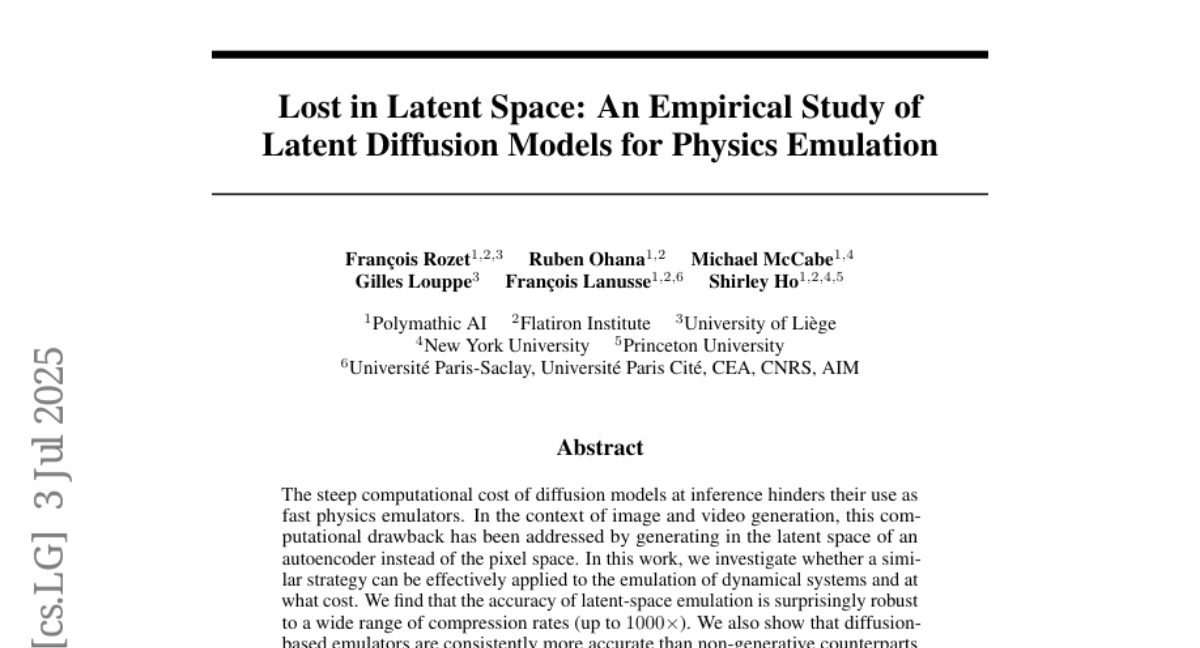
Abstract
Latent-space diffusion models effectively emulate dynamical systems with high accuracy and diversity, even at high compression rates, outperforming non-generative methods.