m1: Unleash the Potential of Test-Time Scaling for Medical Reasoning with Large Language Models
Xiaoke Huang, Juncheng Wu, Hui Liu, Xianfeng Tang, Yuyin Zhou
2025-04-02
Summary
This paper explores how to improve the medical reasoning abilities of AI models by giving them more time to think during testing.
What's the problem?
It's unclear if methods that work for improving AI in math also work for medical reasoning, because medical knowledge and decision-making are different.
What's the solution?
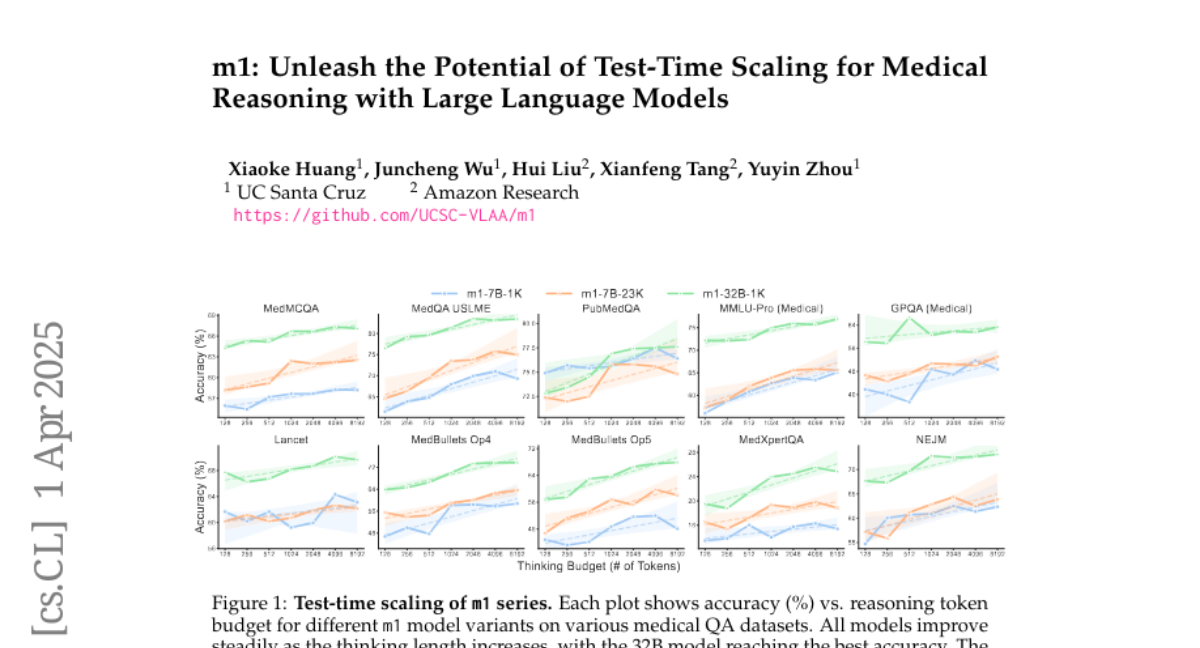
The researchers tested different ways of giving AI models more time to reason during medical tests and found that it generally improves their performance, but only up to a certain point.
Why it matters?
This work matters because it can help create better AI tools for medicine, but it also shows that simply giving AI more time to think isn't enough – it needs more medical knowledge too.
Abstract
Test-time scaling has emerged as a powerful technique for enhancing the reasoning capabilities of large language models. However, its effectiveness in medical reasoning remains uncertain, as the medical domain fundamentally differs from mathematical tasks in terms of knowledge representation and decision-making processes. In this paper, we provide the first comprehensive investigation of test-time scaling for medical reasoning and present m1, a simple yet effective approach that increases a model's medical reasoning capability at inference. Our evaluation across diverse medical tasks demonstrates that test-time scaling consistently enhances medical reasoning, enabling lightweight fine-tuned models under 10B parameters to establish new state-of-the-art performance, while our 32B model rivals previous 70B-scale medical LLMs. However, we identify an optimal reasoning token budget of approximately 4K, beyond which performance may degrade due to overthinking. Budget forcing, which extends test-time computation through iterative prompts, helps models double-check answers but does not necessarily improve the overall medical QA performance and, in some cases, even introduces errors into previously correct responses. Our case-by-case analysis identifies insufficient medical knowledge as a key bottleneck that prevents further performance gains through test-time scaling. We find that increasing data scale, improving data quality, and expanding model capacity consistently enhance medical knowledge grounding, enabling continued performance improvements, particularly on challenging medical benchmarks where smaller models reach saturation. These findings underscore fundamental differences between medical and mathematical reasoning in LLMs, highlighting that enriched medical knowledge, other than increased reasoning depth alone, is essential for realizing the benefits of test-time scaling.