M3: 3D-Spatial MultiModal Memory
Xueyan Zou, Yuchen Song, Ri-Zhao Qiu, Xuanbin Peng, Jianglong Ye, Sifei Liu, Xiaolong Wang
2025-03-21
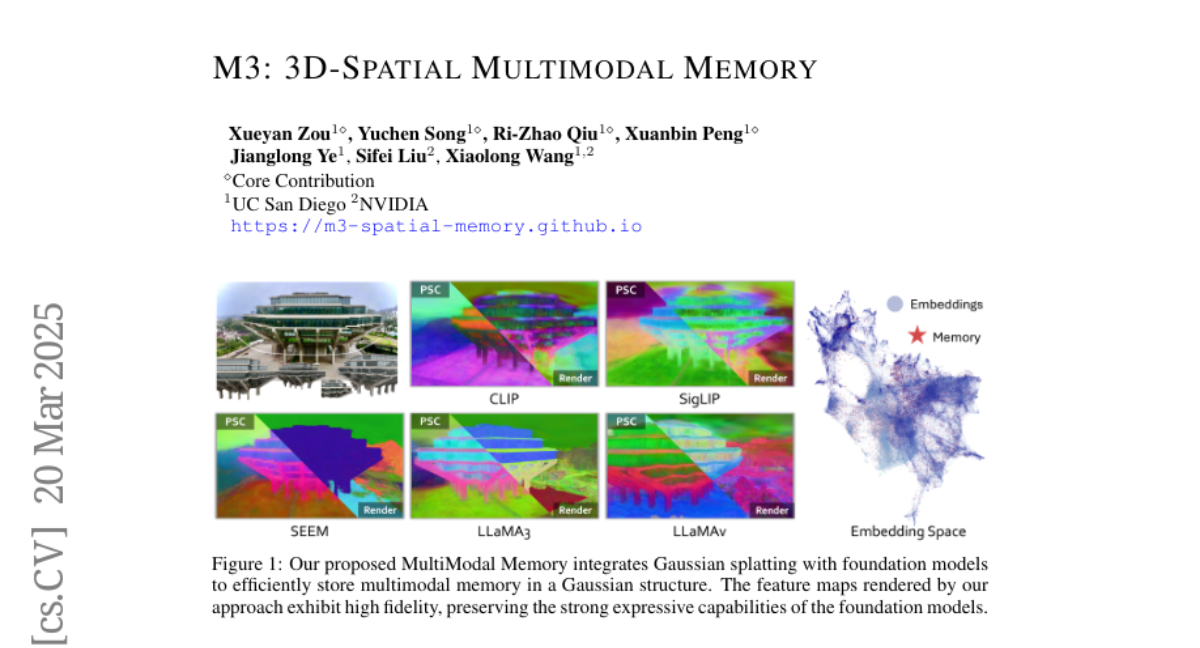
Summary
This paper is about creating a system that helps robots remember what they see in a 3D space using videos.
What's the problem?
It's hard for robots to store and recall detailed information about the 3D environments they navigate, especially using video data.
What's the solution?
The researchers developed a system called M3 that combines 3D modeling techniques with AI to create a memory that can store and recall visual information about a scene.
Why it matters?
This work matters because it can help robots better understand and interact with their surroundings, which is important for tasks like navigation and object recognition.
Abstract
We present 3D Spatial MultiModal Memory (M3), a multimodal memory system designed to retain information about medium-sized static scenes through video sources for visual perception. By integrating 3D Gaussian Splatting techniques with foundation models, M3 builds a multimodal memory capable of rendering feature representations across granularities, encompassing a wide range of knowledge. In our exploration, we identify two key challenges in previous works on feature splatting: (1) computational constraints in storing high-dimensional features for each Gaussian primitive, and (2) misalignment or information loss between distilled features and foundation model features. To address these challenges, we propose M3 with key components of principal scene components and Gaussian memory attention, enabling efficient training and inference. To validate M3, we conduct comprehensive quantitative evaluations of feature similarity and downstream tasks, as well as qualitative visualizations to highlight the pixel trace of Gaussian memory attention. Our approach encompasses a diverse range of foundation models, including vision-language models (VLMs), perception models, and large multimodal and language models (LMMs/LLMs). Furthermore, to demonstrate real-world applicability, we deploy M3's feature field in indoor scenes on a quadruped robot. Notably, we claim that M3 is the first work to address the core compression challenges in 3D feature distillation.