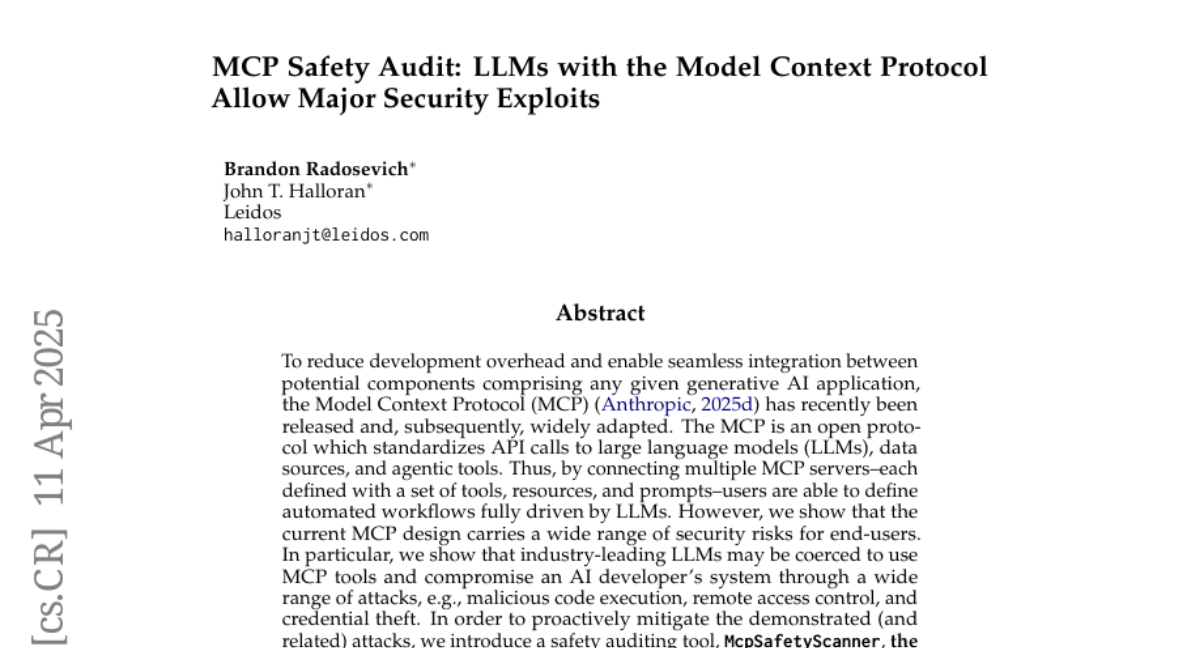
MCP Safety Audit: LLMs with the Model Context Protocol Allow Major Security Exploits
Brandon Radosevich, John Halloran
2025-04-15
Summary
This paper discusses how the Model Context Protocol (MCP), which lets large language models (LLMs) use outside tools and data, has serious security flaws that can be exploited by attackers. It also introduces a tool called MCPSafetyScanner to help find and fix these problems.
What's the problem?
The main problem is that MCP makes it easier for hackers to attack systems that use LLMs. Attackers can trick the model by inserting bad data or commands, steal sensitive information, or even take control of parts of the system. These vulnerabilities happen because MCP often doesn't check who is asking for information, connects to many different systems, and can be manipulated through things like prompt injection or tool poisoning.
What's the solution?
To address these risks, the paper presents MCPSafetyScanner, a special tool designed to test MCP servers for security weaknesses. This scanner helps organizations find out if their MCP setup is vulnerable to different types of attacks so they can fix the issues before hackers exploit them.
Why it matters?
This research is important because as more companies use LLMs with MCP to automate tasks or connect to other tools, the risk of security breaches grows. By understanding and testing for these vulnerabilities, organizations can better protect their systems and sensitive data from being stolen or misused.
Abstract
The Model Context Protocol (MCP) has security vulnerabilities that can be exploited through various attacks, which are mitigated by the introduced agentic tool, MCPSafetyScanner, for assessing MCP server security.