MeshCraft: Exploring Efficient and Controllable Mesh Generation with Flow-based DiTs
Xianglong He, Junyi Chen, Di Huang, Zexiang Liu, Xiaoshui Huang, Wanli Ouyang, Chun Yuan, Yangguang Li
2025-04-01
Summary
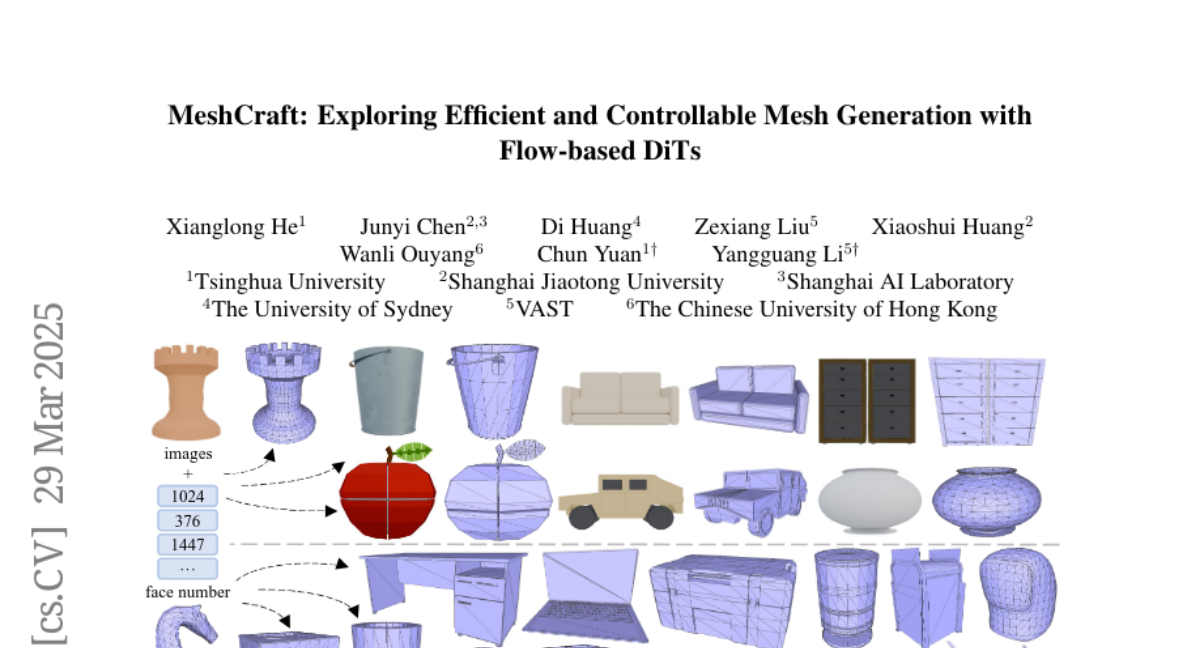
This paper is about a new AI system that creates 3D models (meshes) more quickly and with better control than previous methods.
What's the problem?
Existing AI methods for creating 3D models are slow and don't allow users to easily control the number of faces in the model.
What's the solution?
The researchers developed MeshCraft, which uses a different AI technique to generate 3D models much faster and allows users to specify the number of faces in the model.
Why it matters?
This work matters because it can make 3D modeling more efficient and accessible for artists and designers.
Abstract
In the domain of 3D content creation, achieving optimal mesh topology through AI models has long been a pursuit for 3D artists. Previous methods, such as MeshGPT, have explored the generation of ready-to-use 3D objects via mesh auto-regressive techniques. While these methods produce visually impressive results, their reliance on token-by-token predictions in the auto-regressive process leads to several significant limitations. These include extremely slow generation speeds and an uncontrollable number of mesh faces. In this paper, we introduce MeshCraft, a novel framework for efficient and controllable mesh generation, which leverages continuous spatial diffusion to generate discrete triangle faces. Specifically, MeshCraft consists of two core components: 1) a transformer-based VAE that encodes raw meshes into continuous face-level tokens and decodes them back to the original meshes, and 2) a flow-based diffusion transformer conditioned on the number of faces, enabling the generation of high-quality 3D meshes with a predefined number of faces. By utilizing the diffusion model for the simultaneous generation of the entire mesh topology, MeshCraft achieves high-fidelity mesh generation at significantly faster speeds compared to auto-regressive methods. Specifically, MeshCraft can generate an 800-face mesh in just 3.2 seconds (35times faster than existing baselines). Extensive experiments demonstrate that MeshCraft outperforms state-of-the-art techniques in both qualitative and quantitative evaluations on ShapeNet dataset and demonstrates superior performance on Objaverse dataset. Moreover, it integrates seamlessly with existing conditional guidance strategies, showcasing its potential to relieve artists from the time-consuming manual work involved in mesh creation.