Met^2Net: A Decoupled Two-Stage Spatio-Temporal Forecasting Model for Complex Meteorological Systems
Shaohan Li, Hao Yang, Min Chen, Xiaolin Qin
2025-07-29
Summary
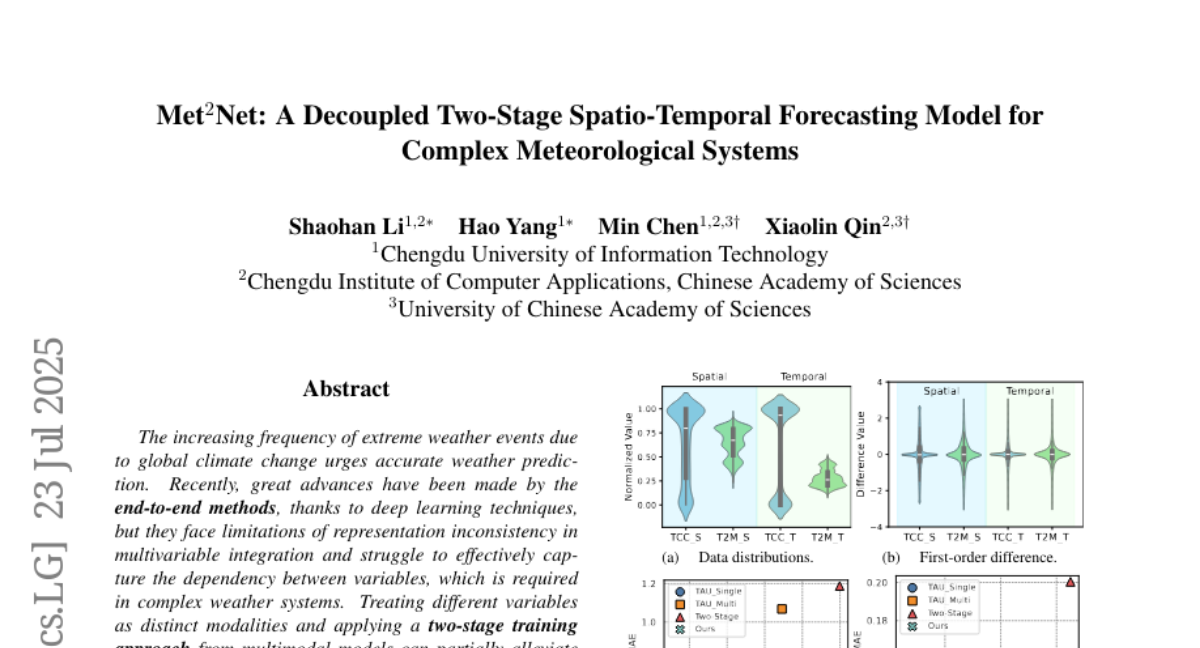
This paper talks about Met^2Net, a new weather forecasting model that improves how predictions are made by separating the learning process into two stages and using special techniques to combine information about different weather variables.
What's the problem?
The problem is that predicting complex weather systems is very hard because many weather elements like temperature, humidity, and wind affect each other in complicated ways. Previous models struggled with inconsistent data interpretation and had trouble capturing how these variables depend on one another well.
What's the solution?
Met^2Net solves this by training separate parts of the model called encoders and decoders for each weather variable first, and then using another part called the translator that learns how these different variables interact with each other. It uses a method called self-attention to effectively combine this information. This two-stage training keeps the focus on making accurate forecasts while ensuring the model learns the relationships between variables better.
Why it matters?
This matters because more accurate weather predictions help us prepare better for extreme weather and understand climate changes. A better forecasting model can save lives, protect property, and improve planning in many areas affected by the weather.
Abstract
An implicit two-stage training method with separate encoders, decoders, and a translator, enhanced by self-attention, improves weather prediction accuracy.