MetaSpatial: Reinforcing 3D Spatial Reasoning in VLMs for the Metaverse
Zhenyu Pan, Han Liu
2025-03-25
Summary
This paper is about making AI better at creating realistic 3D scenes, like the kind you might see in a video game or virtual reality.
What's the problem?
AI models often struggle to create 3D environments that look realistic because they don't understand how objects should be arranged in space.
What's the solution?
The researchers developed a new method called MetaSpatial that uses a type of AI learning called reinforcement learning to teach the AI how to create more realistic and visually appealing 3D layouts.
Why it matters?
This work matters because it can lead to more immersive and believable experiences in virtual worlds, augmented reality, and other 3D applications.
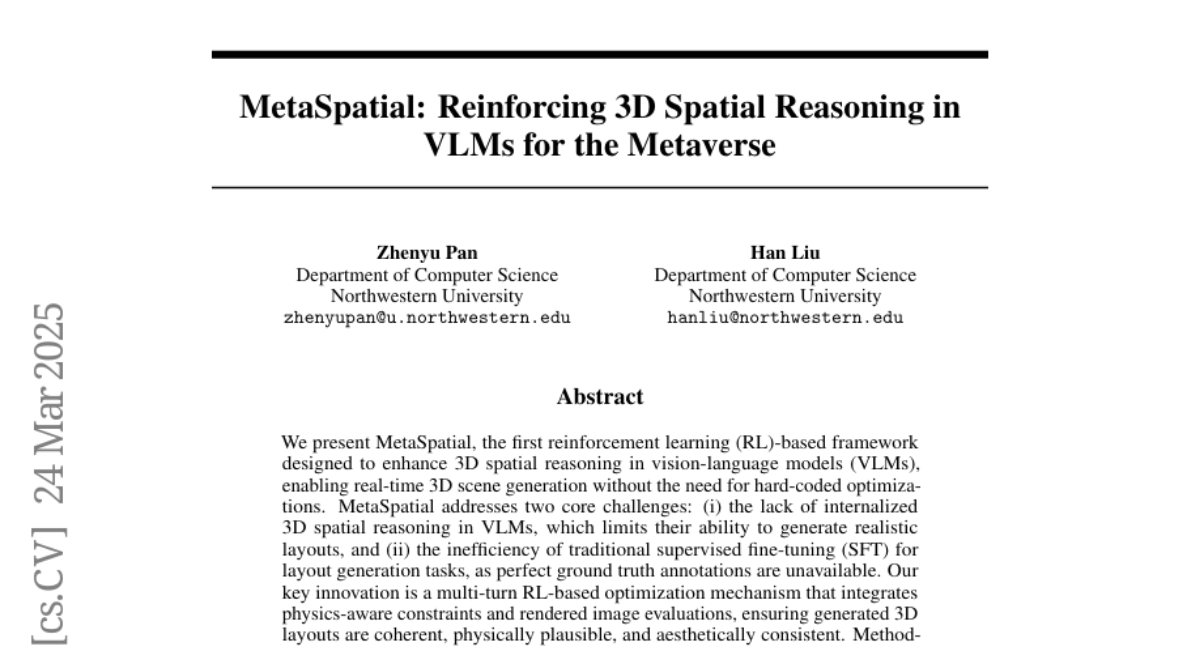
Abstract
We present MetaSpatial, the first reinforcement learning (RL)-based framework designed to enhance 3D spatial reasoning in vision-language models (VLMs), enabling real-time 3D scene generation without the need for hard-coded optimizations. MetaSpatial addresses two core challenges: (i) the lack of internalized 3D spatial reasoning in VLMs, which limits their ability to generate realistic layouts, and (ii) the inefficiency of traditional supervised fine-tuning (SFT) for layout generation tasks, as perfect ground truth annotations are unavailable. Our key innovation is a multi-turn RL-based optimization mechanism that integrates physics-aware constraints and rendered image evaluations, ensuring generated 3D layouts are coherent, physically plausible, and aesthetically consistent. Methodologically, MetaSpatial introduces an adaptive, iterative reasoning process, where the VLM refines spatial arrangements over multiple turns by analyzing rendered outputs, improving scene coherence progressively. Empirical evaluations demonstrate that MetaSpatial significantly enhances the spatial consistency and formatting stability of various scale models. Post-training, object placements are more realistic, aligned, and functionally coherent, validating the effectiveness of RL for 3D spatial reasoning in metaverse, AR/VR, digital twins, and game development applications. Our code, data, and training pipeline are publicly available at https://github.com/PzySeere/MetaSpatial.