MicroVQA: A Multimodal Reasoning Benchmark for Microscopy-Based Scientific Research
James Burgess, Jeffrey J Nirschl, Laura Bravo-Sánchez, Alejandro Lozano, Sanket Rajan Gupte, Jesus G. Galaz-Montoya, Yuhui Zhang, Yuchang Su, Disha Bhowmik, Zachary Coman, Sarina M. Hasan, Alexandra Johannesson, William D. Leineweber, Malvika G Nair, Ridhi Yarlagadda, Connor Zuraski, Wah Chiu, Sarah Cohen, Jan N. Hansen, Manuel D Leonetti, Chad Liu, Emma Lundberg
2025-03-18
Summary
This paper introduces MicroVQA, a new benchmark designed to test how well AI models can reason about complex scientific data, specifically images from microscopes.
What's the problem?
Current AI benchmarks don't adequately test the reasoning skills needed for scientific research, especially in biology. Existing benchmarks are either too easy or focus on simple image recognition, not the complex reasoning required to analyze scientific data.
What's the solution?
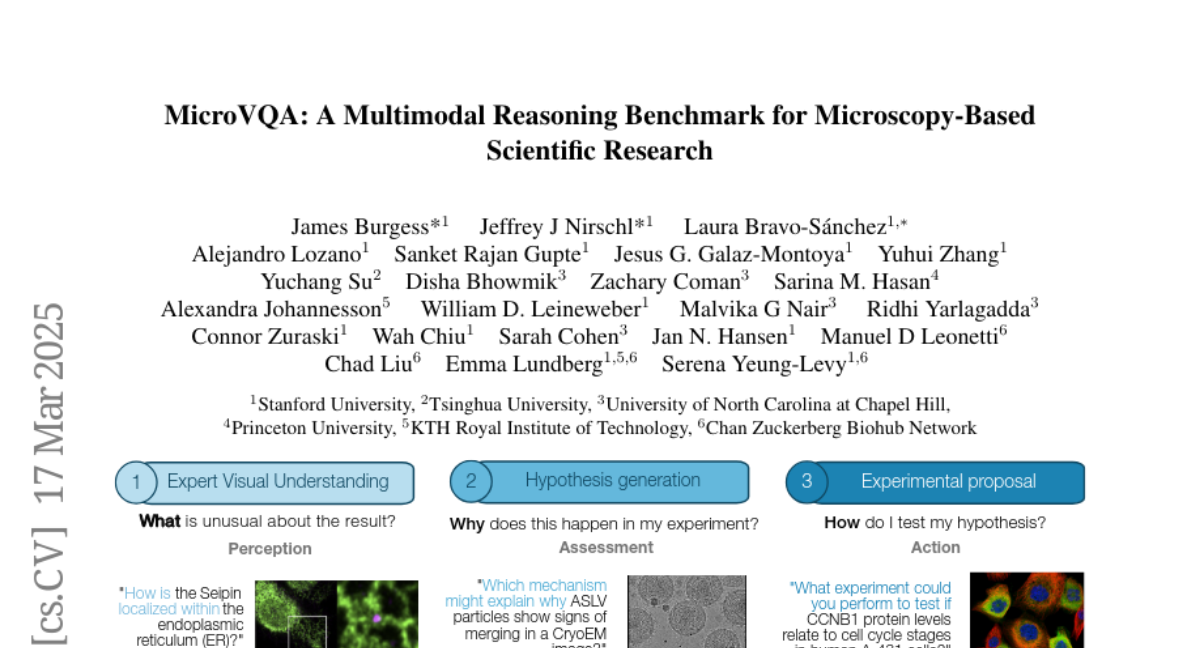
The researchers created MicroVQA, a visual question answering (VQA) benchmark with challenging multiple-choice questions created by biology experts. The questions require expert image understanding, hypothesis generation, and experiment proposal. They also developed a method to prevent AI models from taking shortcuts when answering the questions.
Why it matters?
This work matters because it provides a valuable tool for developing AI systems that can assist scientists in analyzing complex data and making new discoveries in fields like biology and medicine.
Abstract
Scientific research demands sophisticated reasoning over multimodal data, a challenge especially prevalent in biology. Despite recent advances in multimodal large language models (MLLMs) for AI-assisted research, existing multimodal reasoning benchmarks only target up to college-level difficulty, while research-level benchmarks emphasize lower-level perception, falling short of the complex multimodal reasoning needed for scientific discovery. To bridge this gap, we introduce MicroVQA, a visual-question answering (VQA) benchmark designed to assess three reasoning capabilities vital in research workflows: expert image understanding, hypothesis generation, and experiment proposal. MicroVQA consists of 1,042 multiple-choice questions (MCQs) curated by biology experts across diverse microscopy modalities, ensuring VQA samples represent real scientific practice. In constructing the benchmark, we find that standard MCQ generation methods induce language shortcuts, motivating a new two-stage pipeline: an optimized LLM prompt structures question-answer pairs into MCQs; then, an agent-based `RefineBot' updates them to remove shortcuts. Benchmarking on state-of-the-art MLLMs reveal a peak performance of 53\%; models with smaller LLMs only slightly underperform top models, suggesting that language-based reasoning is less challenging than multimodal reasoning; and tuning with scientific articles enhances performance. Expert analysis of chain-of-thought responses shows that perception errors are the most frequent, followed by knowledge errors and then overgeneralization errors. These insights highlight the challenges in multimodal scientific reasoning, showing MicroVQA is a valuable resource advancing AI-driven biomedical research. MicroVQA is available at https://huggingface.co/datasets/jmhb/microvqa, and project page at https://jmhb0.github.io/microvqa.