Ming-Omni: A Unified Multimodal Model for Perception and Generation
Inclusion AI, Biao Gong, Cheng Zou, Chuanyang Zheng, Chunluan Zhou, Canxiang Yan, Chunxiang Jin, Chunjie Shen, Dandan Zheng, Fudong Wang, Furong Xu, GuangMing Yao, Jun Zhou, Jingdong Chen, Jianxin Sun, Jiajia Liu, Jianjiang Zhu, Jun Peng, Kaixiang Ji, Kaiyou Song, Kaimeng Ren, Libin Wang
2025-06-15
Summary
This paper talks about Ming-Omni, a powerful AI model that can understand and create many types of content like pictures, words, sounds, and videos all in one system. It can do things like generate speech and images, have conversations that consider the situation, and edit images in various ways.
What's the problem?
The problem is that most AI models only focus on one type of content, like just text or just images, which limits what they can do. Combining many types like images, audio, video, and text into one model is very hard because each type needs different ways to be processed and understood.
What's the solution?
The solution was to build Ming-Omni with special parts called encoders for each type of content and routers that decide how to handle each kind of input. This design lets the model work well with different kinds of tasks, like generating speech or editing images, while keeping everything connected in one system.
Why it matters?
This matters because having one AI that can understand and create many kinds of media makes it easier to build smart tools that can talk, see, listen, and create all at once. This can lead to more useful and flexible AI systems that help with everything from chatting and storytelling to multimedia editing.
Abstract
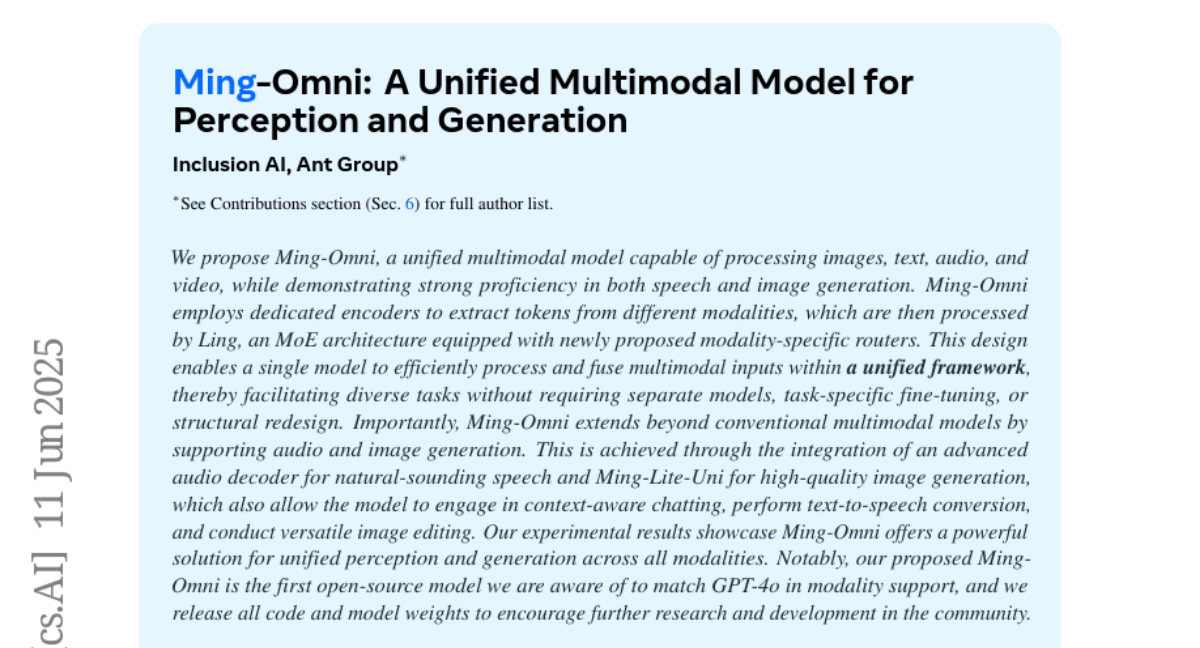
Ming-Omni is a unified multimodal model with dedicated encoders and modality-specific routers that can process images, text, audio, and video, and performs tasks like speech and image generation, context-aware chatting, and versatile image editing.