MLRC-Bench: Can Language Agents Solve Machine Learning Research Challenges?
Yunxiang Zhang, Muhammad Khalifa, Shitanshu Bhushan, Grant D Murphy, Lajanugen Logeswaran, Jaekyeom Kim, Moontae Lee, Honglak Lee, Lu Wang
2025-04-17
Summary
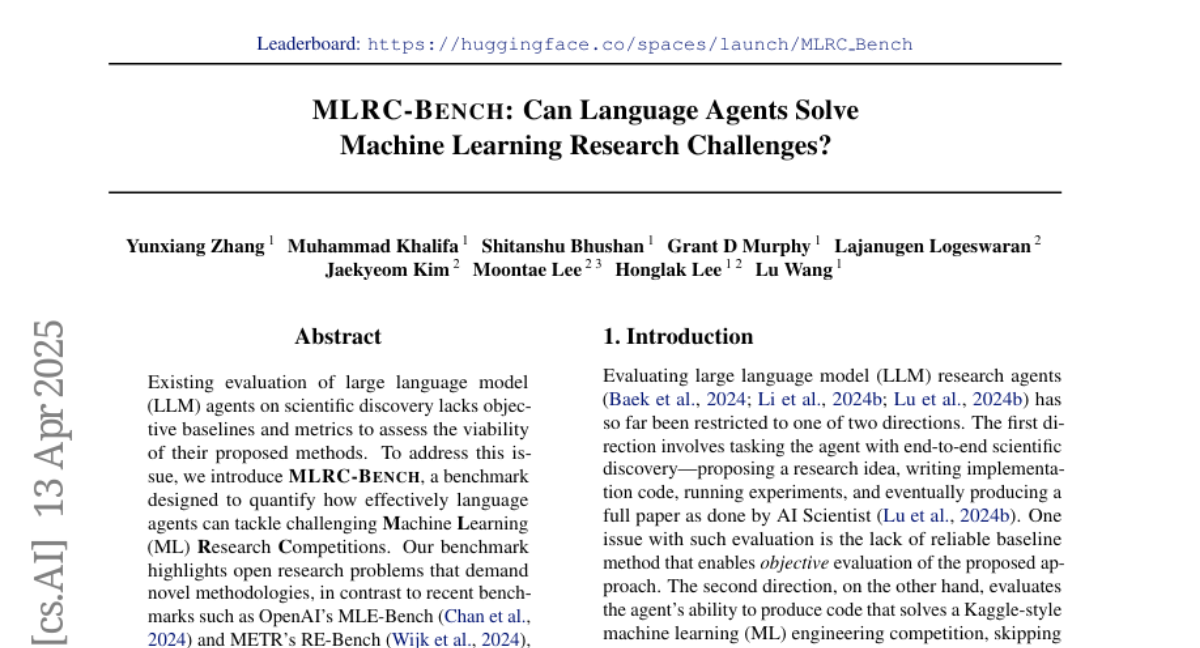
This paper talks about MLRC-Bench, a new way to test how well language model agents, like advanced AI chatbots, can actually solve real machine learning research problems, not just answer simple questions.
What's the problem?
The problem is that while language models have gotten really good at answering trivia or following instructions, it's unclear if they can handle the much harder tasks involved in real scientific research, like coming up with new ideas or solving open-ended challenges. Previous tests haven't been tough enough to show where these models struggle.
What's the solution?
The researchers set up MLRC-Bench, which uses strict rules and clear scoring methods to see how well language model agents perform on actual research competitions. They found that these AIs face a lot of difficulties and don't always align with what real researchers would do, showing that there's still a big gap between current AI abilities and true research-level problem solving.
Why it matters?
This matters because it helps scientists understand the limits of current AI and shows where improvements are needed before these models can really help with cutting-edge research. It also sets a higher standard for what it means for an AI to be useful in science and engineering.
Abstract
MLRC-Bench evaluates large language model agents in tackling novel machine learning research competitions using rigorous protocols and objective metrics, highlighting significant challenges and misalignments compared to previous benchmarks.