MM-Spatial: Exploring 3D Spatial Understanding in Multimodal LLMs
Erik Daxberger, Nina Wenzel, David Griffiths, Haiming Gang, Justin Lazarow, Gefen Kohavi, Kai Kang, Marcin Eichner, Yinfei Yang, Afshin Dehghan, Peter Grasch
2025-03-19
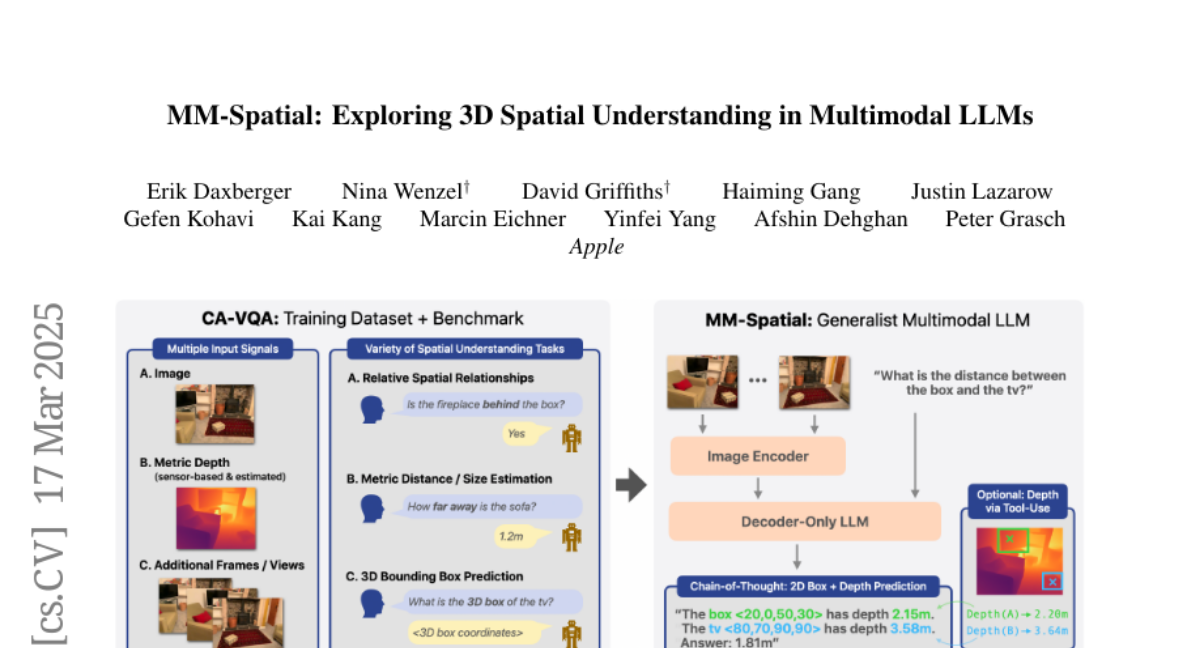
Summary
This paper explores how well AI models that understand both images and text can understand 3D spaces.
What's the problem?
AI models are good at understanding 2D images, but struggle with understanding 3D environments.
What's the solution?
The researchers created a new dataset and a set of tests to train and evaluate AI models on 3D spatial tasks, like predicting spatial relationships and estimating distances.
Why it matters?
This work matters because it helps improve AI's ability to understand and interact with the real world, which is important for applications like robotics and virtual reality.
Abstract
Multimodal large language models (MLLMs) excel at 2D visual understanding but remain limited in their ability to reason about 3D space. In this work, we leverage large-scale high-quality 3D scene data with open-set annotations to introduce 1) a novel supervised fine-tuning dataset and 2) a new evaluation benchmark, focused on indoor scenes. Our Cubify Anything VQA (CA-VQA) data covers diverse spatial tasks including spatial relationship prediction, metric size and distance estimation, and 3D grounding. We show that CA-VQA enables us to train MM-Spatial, a strong generalist MLLM that also achieves state-of-the-art performance on 3D spatial understanding benchmarks, including our own. We show how incorporating metric depth and multi-view inputs (provided in CA-VQA) can further improve 3D understanding, and demonstrate that data alone allows our model to achieve depth perception capabilities comparable to dedicated monocular depth estimation models. We will publish our SFT dataset and benchmark.