ModernBERT or DeBERTaV3? Examining Architecture and Data Influence on Transformer Encoder Models Performance
Wissam Antoun, Benoît Sagot, Djamé Seddah
2025-04-14
Summary
This paper talks about a comparison between two types of AI language models, ModernBERT and CamemBERTaV2, to see which one works better and why. The researchers wanted to find out how changes in the model's design and the data used for training affect how well these models understand and process language.
What's the problem?
The problem is that there are many different designs for these powerful language models, and it's not always clear which design choices actually make a model better or more efficient. People want models that perform well on language tasks, use less data to learn, and are quick to train and use, but it's tricky to balance all these goals.
What's the solution?
The researchers ran a controlled study where they carefully tested both ModernBERT and CamemBERTaV2 on the same tasks and with the same data. They measured how much data each model needed to learn effectively, how well they did on standard language tests, and how fast they trained and made predictions. They found that CamemBERTaV2, which sticks closer to the original model design, was better at learning from less data and scored higher on benchmarks, while ModernBERT was faster overall.
Why it matters?
This work matters because it helps AI developers and researchers understand the trade-offs between different model designs. Knowing which models are more efficient or perform better can lead to smarter choices when building new language technologies, making them more useful and accessible in real-world applications.
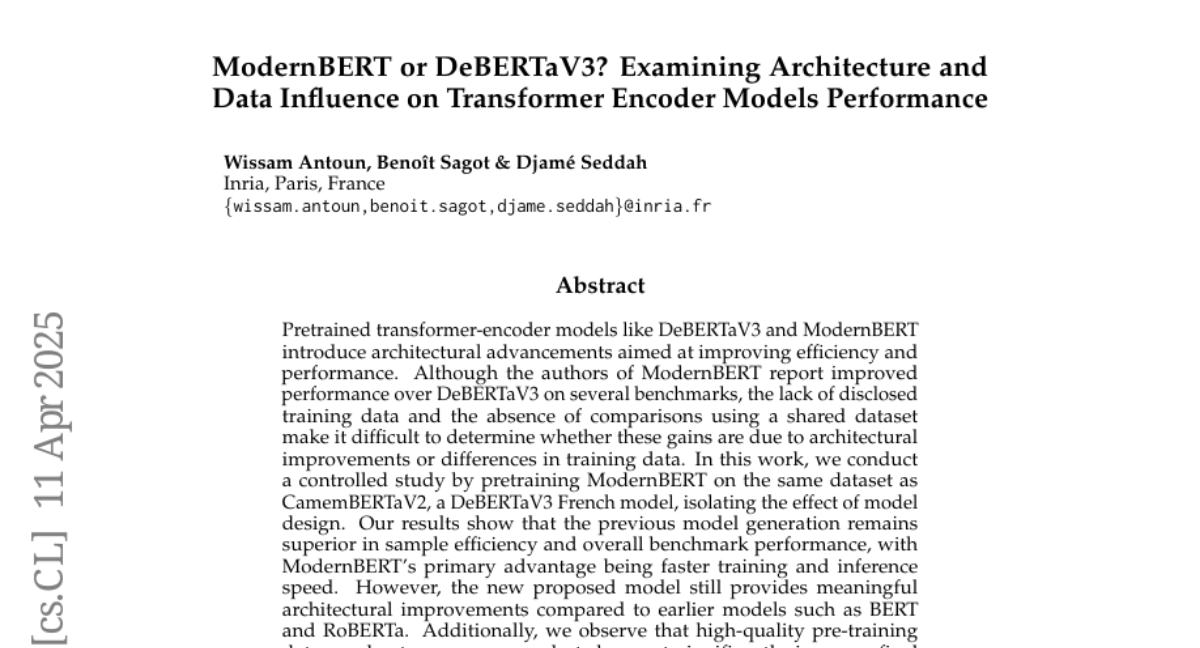
Abstract
A controlled study comparing ModernBERT with CamemBERTaV2 demonstrates that the original model design remains superior in sample efficiency and benchmark performance, though ModernBERT offers faster training and inference.