MOOSE-Chem3: Toward Experiment-Guided Hypothesis Ranking via Simulated Experimental Feedback
Wanhao Liu, Zonglin Yang, Jue Wang, Lidong Bing, Di Zhang, Dongzhan Zhou, Yuqiang Li, Houqiang Li, Erik Cambria, Wanli Ouyang
2025-05-26
Summary
This paper talks about MOOSE-Chem3, a new system that helps scientists figure out which ideas or hypotheses to test first by using a simulator that predicts what might happen in experiments.
What's the problem?
The problem is that in scientific research, there are often many possible ideas to test, but it's hard to know which ones are most likely to succeed or be important. Testing every idea in real experiments takes a lot of time and resources.
What's the solution?
The researchers built a simulator that can mimic what would happen in real experiments and used it to help rank and prioritize hypotheses. By seeing which ideas are more likely to work based on simulated results, scientists can focus on the most promising ones before doing actual experiments.
Why it matters?
This is important because it makes scientific discovery faster and more efficient, saving time and resources while helping researchers focus on the ideas that are most likely to lead to breakthroughs.
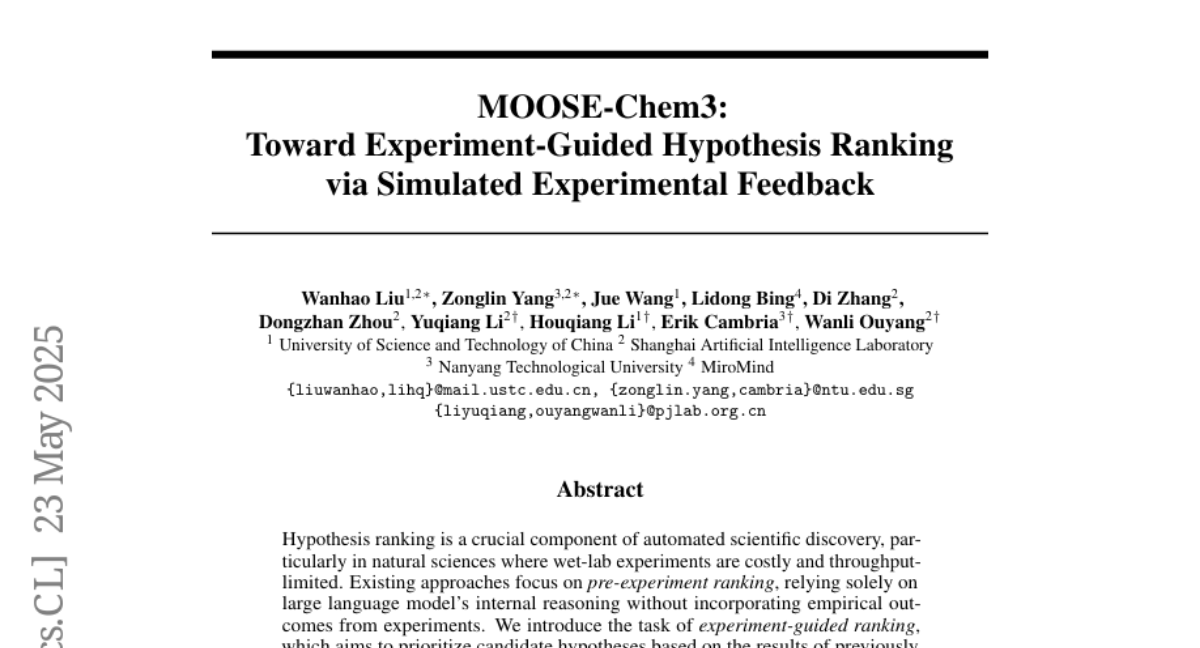
Abstract
A novel simulator and experiment-guided ranking method improve hypothesis prioritization in scientific discovery by incorporating simulated experimental outcomes.