Neural-Driven Image Editing
Pengfei Zhou, Jie Xia, Xiaopeng Peng, Wangbo Zhao, Zilong Ye, Zekai Li, Suorong Yang, Jiadong Pan, Yuanxiang Chen, Ziqiao Wang, Kai Wang, Qian Zheng, Xiaojun Chang, Gang Pan, Shurong Dong, Kaipeng Zhang, Yang You
2025-07-14
Summary
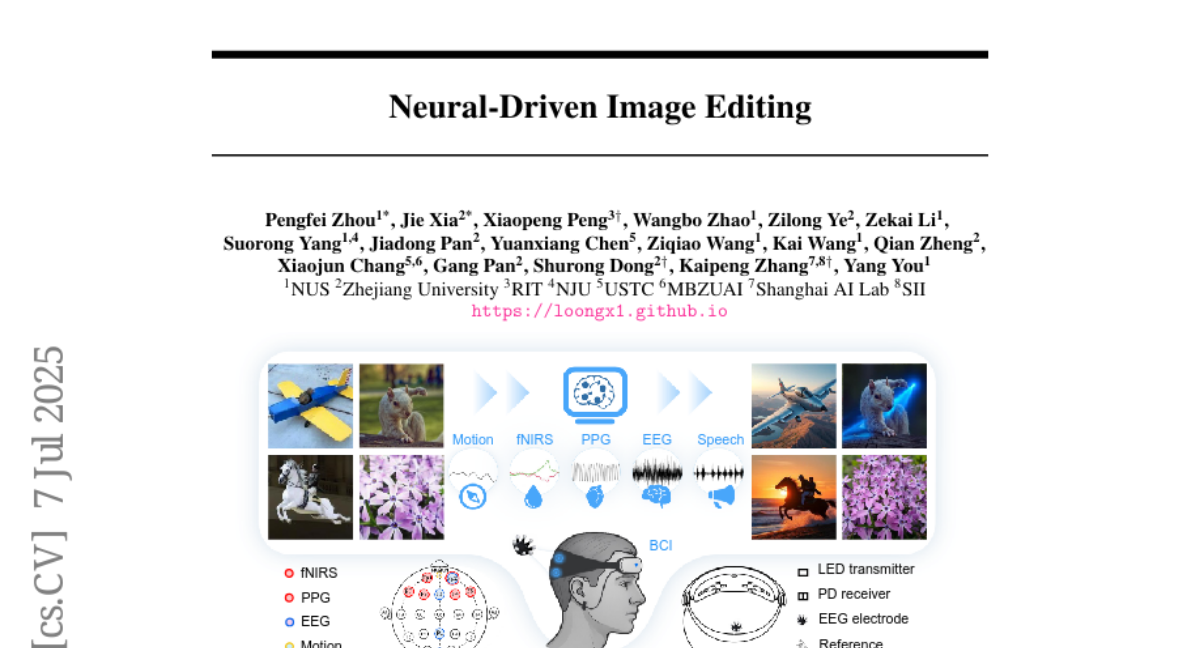
This paper talks about LoongX, an innovative image editing system that lets users edit pictures without using their hands, by reading brain signals and other body signals combined with AI models.
What's the problem?
Traditional image editing needs manual work like typing or clicking, which is hard or impossible for people with limited movement or speech abilities, making creative editing inaccessible for them.
What's the solution?
The researchers developed LoongX, which captures brain and physiological signals like EEG and others, then processes these signals through special modules to understand the user's intentions and guide the AI to edit images. It works as well as text-based methods and even better when combined with speech.
Why it matters?
This matters because LoongX opens up new ways for people with physical limitations to creatively edit images easily and intuitively, making technology more inclusive and showing how AI and brain-computer interfaces can work together for better human-computer interaction.
Abstract
LoongX, a hands-free image editing system, uses multimodal neurophysiological signals and diffusion models to achieve performance comparable to text-driven methods and outperforms them when combined with speech.