NeuralOS: Towards Simulating Operating Systems via Neural Generative Models
Luke Rivard, Sun Sun, Hongyu Guo, Wenhu Chen, Yuntian Deng
2025-07-14
Summary
This paper talks about NeuralOS, a new system that uses AI to simulate how an operating system's screen looks and changes based on what the user does, like moving the mouse or typing on the keyboard.
What's the problem?
Simulating a real operating system's graphical interface is very complex because it requires keeping track of many things happening on the screen and responding quickly and accurately to user actions, which is hard for AI to do smoothly.
What's the solution?
The researchers combined two types of neural networks: one that remembers the computer's current state and what actions have happened, and another that creates realistic images of the screen. They trained this system on lots of real user interactions from an actual operating system to make its predictions accurate and natural.
Why it matters?
This matters because NeuralOS is a step toward making fully AI-driven operating systems that can adapt, respond, and generate interfaces without traditional programming. This could change how computers interact with people in the future, making interfaces more flexible and intelligent.
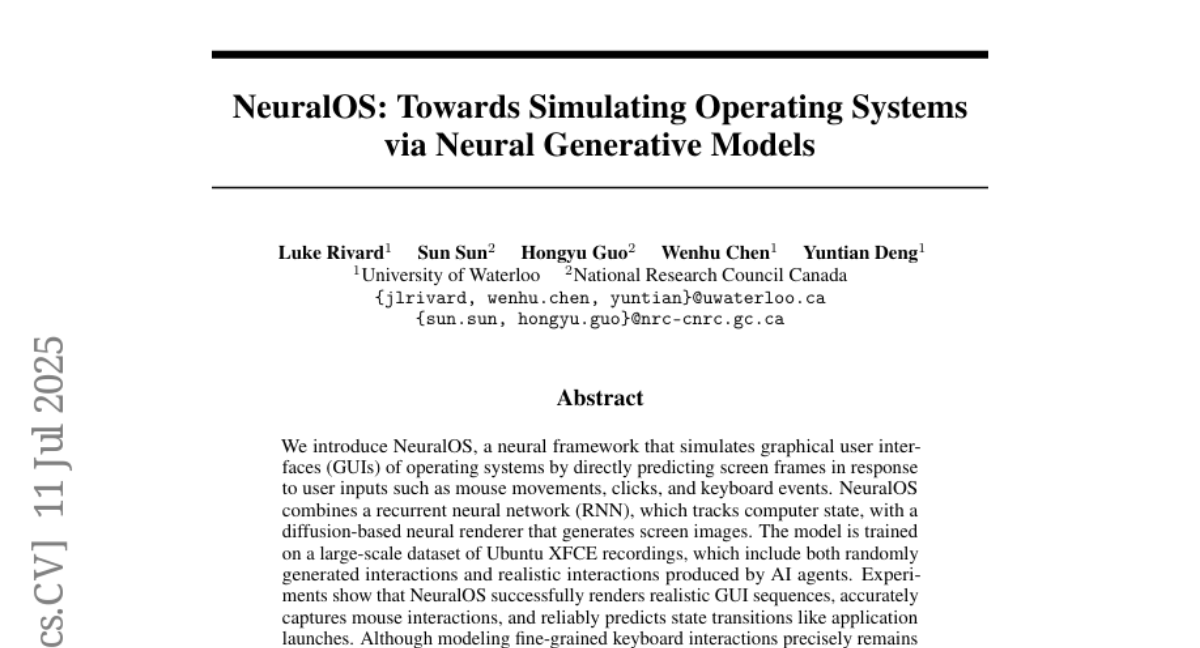
Abstract
NeuralOS, a neural framework combining RNNs and diffusion-based rendering, simulates realistic GUIs by predicting screen frames in response to user inputs.