Neurosymbolic Diffusion Models
Emile van Krieken, Pasquale Minervini, Edoardo Ponti, Antonio Vergari
2025-05-21
Summary
This paper talks about neurosymbolic diffusion models, which are a new kind of AI that combines brain-like learning with logical reasoning to make smarter predictions.
What's the problem?
The problem is that regular neurosymbolic models, which try to mix human-like thinking with AI, often don't do a good job of understanding how different symbols or ideas relate to each other, which can make their answers less accurate and reliable.
What's the solution?
To fix this, the researchers used a method called discrete diffusion to help the AI better model and understand the connections between different symbols. This approach makes the predictions more accurate and better calibrated, meaning the AI is more confident and correct in its answers.
Why it matters?
This matters because it could lead to AI systems that are both logical and creative, making them more trustworthy and useful for solving complex problems in science, technology, and everyday life.
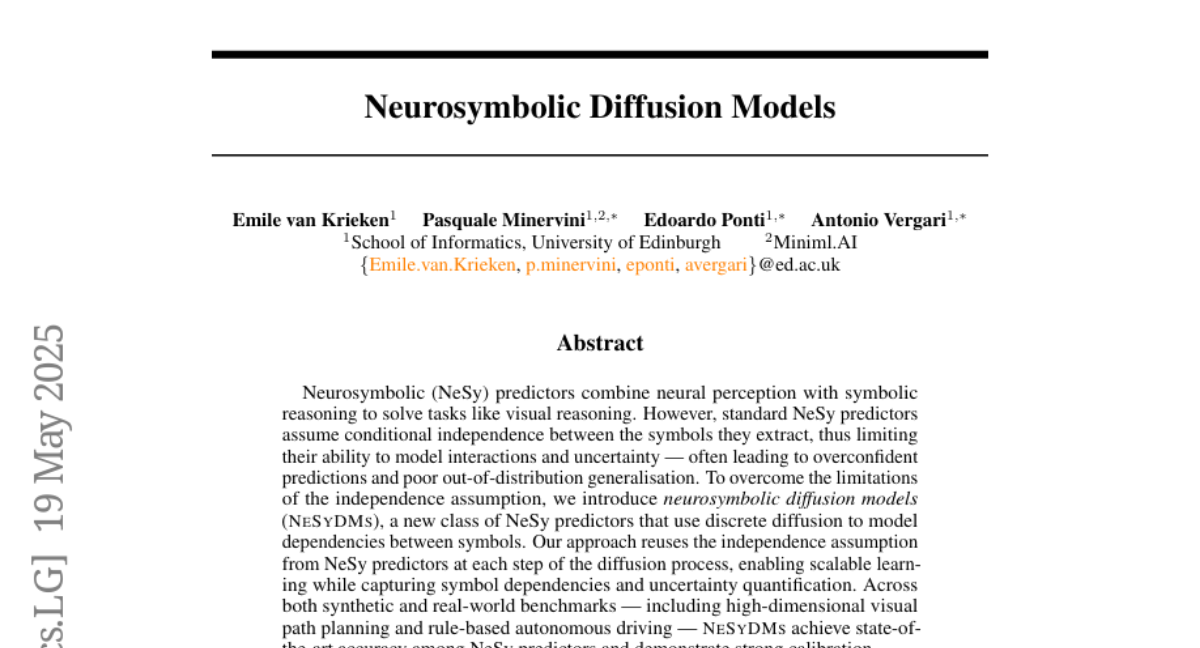
Abstract
Neurosymbolic diffusion models address limitations of standard neurosymbolic predictors by modeling dependencies between symbols using discrete diffusion, leading to improved accuracy and calibration.