New Trends for Modern Machine Translation with Large Reasoning Models
Sinuo Liu, Chenyang Lyu, Minghao Wu, Longyue Wang, Weihua Luo, Kaifu Zhang
2025-03-14
Summary
This paper talks about how new AI models that think step-by-step are changing translation tools by making them smarter at understanding context, culture, and fixing their own mistakes, rather than just swapping words between languages.
What's the problem?
Old translation tools often mess up jokes, idioms, or long texts because they don’t understand deeper meanings, cultural differences, or how sentences connect across paragraphs.
What's the solution?
The new AI models act like multilingual problem-solvers, breaking down translations into thinking steps to handle tricky phrases, guess cultural intentions, and even check their own work for errors during the process.
Why it matters?
This makes translators more reliable for books, movies, or business deals, helping people share ideas accurately across languages without losing humor, tone, or hidden meanings.
Abstract
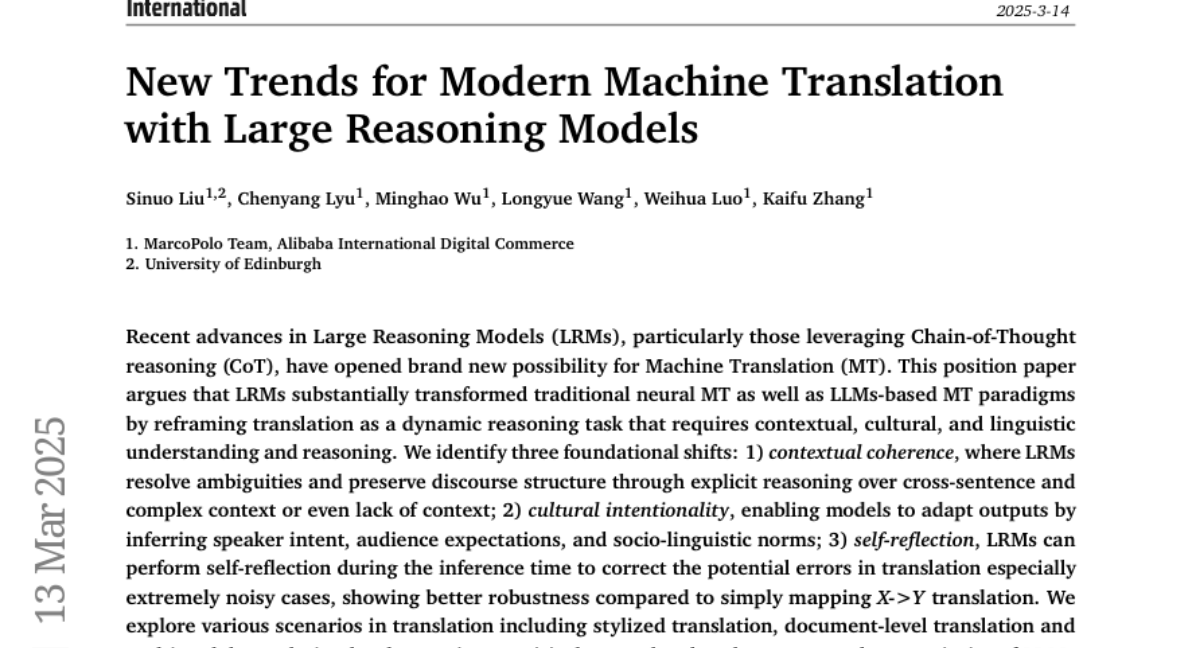
Recent advances in Large Reasoning Models (LRMs), particularly those leveraging Chain-of-Thought reasoning (CoT), have opened brand new possibility for Machine Translation (MT). This position paper argues that LRMs substantially transformed traditional neural MT as well as LLMs-based MT paradigms by reframing translation as a dynamic reasoning task that requires contextual, cultural, and linguistic understanding and reasoning. We identify three foundational shifts: 1) contextual coherence, where LRMs resolve ambiguities and preserve discourse structure through explicit reasoning over cross-sentence and complex context or even lack of context; 2) cultural intentionality, enabling models to adapt outputs by inferring speaker intent, audience expectations, and socio-linguistic norms; 3) self-reflection, LRMs can perform self-reflection during the inference time to correct the potential errors in translation especially extremely noisy cases, showing better robustness compared to simply mapping X->Y translation. We explore various scenarios in translation including stylized translation, document-level translation and multimodal translation by showcasing empirical examples that demonstrate the superiority of LRMs in translation. We also identify several interesting phenomenons for LRMs for MT including auto-pivot translation as well as the critical challenges such as over-localisation in translation and inference efficiency. In conclusion, we think that LRMs redefine translation systems not merely as text converters but as multilingual cognitive agents capable of reasoning about meaning beyond the text. This paradigm shift reminds us to think of problems in translation beyond traditional translation scenarios in a much broader context with LRMs - what we can achieve on top of it.