Next Token Is Enough: Realistic Image Quality and Aesthetic Scoring with Multimodal Large Language Model
Mingxing Li, Rui Wang, Lei Sun, Yancheng Bai, Xiangxiang Chu
2025-03-11
Summary
This paper talks about a new AI method that uses advanced language-image models to score how good or beautiful user-uploaded photos are, by breaking down ratings into detailed aspects like clarity, subject focus, and composition.
What's the problem?
Rating photos with a single number oversimplifies how people judge images, and it’s hard to get AI models to output precise scores that match human opinions.
What's the solution?
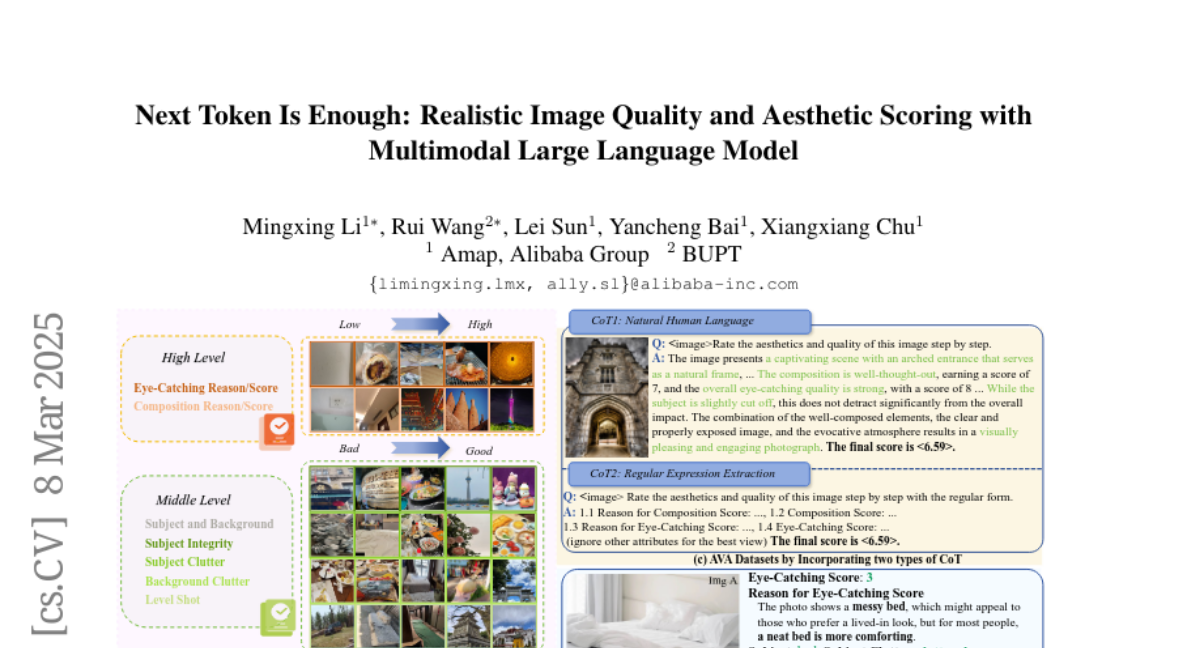
The method uses a dataset (RealQA) with 14,715 photos rated on 10 detailed features, and trains AI to predict scores by focusing on extra decimal points and using step-by-step reasoning to mimic how humans analyze images.
Why it matters?
This helps apps like photo editors or social media platforms automatically pick the best images by understanding detailed quality factors, making automatic ratings more accurate and trustworthy.
Abstract
The rapid expansion of mobile internet has resulted in a substantial increase in user-generated content (UGC) images, thereby making the thorough assessment of UGC images both urgent and essential. Recently, multimodal large language models (MLLMs) have shown great potential in image quality assessment (IQA) and image aesthetic assessment (IAA). Despite this progress, effectively scoring the quality and aesthetics of UGC images still faces two main challenges: 1) A single score is inadequate to capture the hierarchical human perception. 2) How to use MLLMs to output numerical scores, such as mean opinion scores (MOS), remains an open question. To address these challenges, we introduce a novel dataset, named Realistic image Quality and Aesthetic (RealQA), including 14,715 UGC images, each of which is annoted with 10 fine-grained attributes. These attributes span three levels: low level (e.g., image clarity), middle level (e.g., subject integrity) and high level (e.g., composition). Besides, we conduct a series of in-depth and comprehensive investigations into how to effectively predict numerical scores using MLLMs. Surprisingly, by predicting just two extra significant digits, the next token paradigm can achieve SOTA performance. Furthermore, with the help of chain of thought (CoT) combined with the learnt fine-grained attributes, the proposed method can outperform SOTA methods on five public datasets for IQA and IAA with superior interpretability and show strong zero-shot generalization for video quality assessment (VQA). The code and dataset will be released.