NodeRAG: Structuring Graph-based RAG with Heterogeneous Nodes
Tianyang Xu, Haojie Zheng, Chengze Li, Haoxiang Chen, Yixin Liu, Ruoxi Chen, Lichao Sun
2025-04-21
Summary
This paper talks about NodeRAG, a new system that uses graph structures with different types of nodes to help AI models find and use information more effectively when answering questions.
What's the problem?
The problem is that current Retrieval-augmented Generation (RAG) systems, which combine searching for information and generating answers, often struggle to organize and connect different pieces of data, especially when the information comes in many forms or from different sources. This can make the answers less accurate or complete.
What's the solution?
The researchers created NodeRAG, which organizes information as a graph with various types of nodes, each representing different kinds of data. This structure helps the AI understand how different pieces of information are related, making it better at finding the right facts and putting them together for more accurate answers.
Why it matters?
This matters because it makes AI systems much better at handling complex questions and using information from lots of different sources, which is important for research, education, and any situation where getting the right answer really matters.
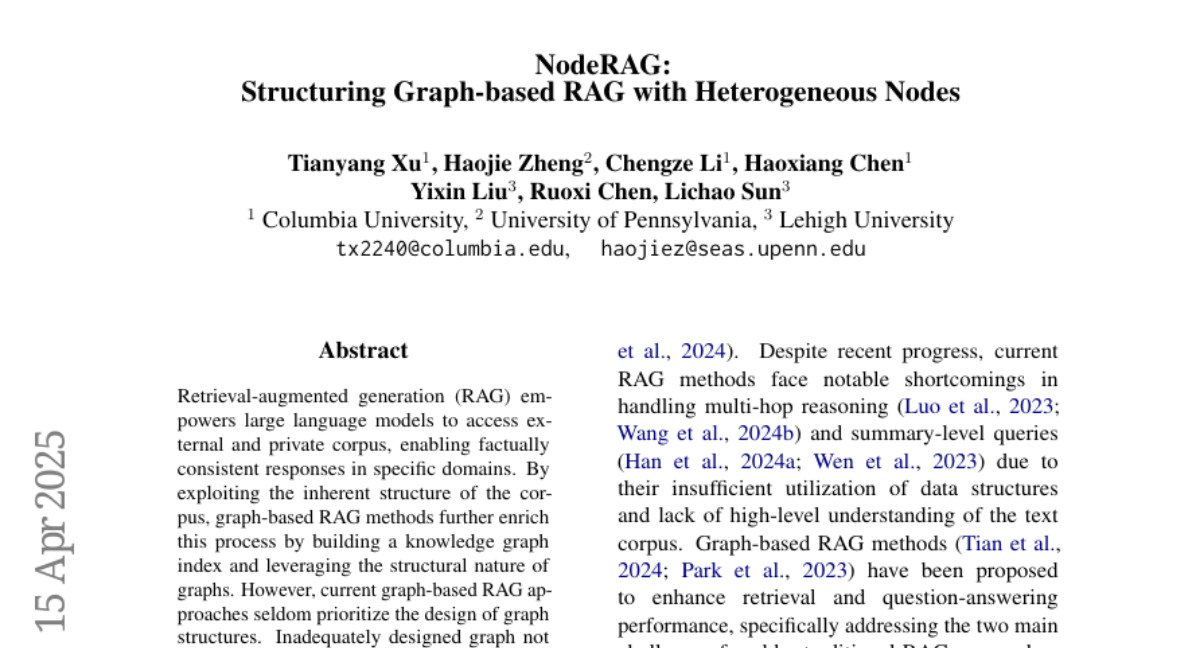
Abstract
NodeRAG, a graph-centric framework with heterogeneous graph structures, enhances Retrieval-augmented Generation (RAG) by improving integration and performance in indexing, querying, and question-answering.