Omni-R1: Reinforcement Learning for Omnimodal Reasoning via Two-System Collaboration
Hao Zhong, Muzhi Zhu, Zongze Du, Zheng Huang, Canyu Zhao, Mingyu Liu, Wen Wang, Hao Chen, Chunhua Shen
2025-05-27
Summary
This paper talks about a new way to train AI called Omni-R1, which uses reinforcement learning to help computers get really good at understanding and reasoning about both videos and audio, even when the tasks are complicated and require paying attention to tiny details.
What's the problem?
The problem is that most AI systems struggle when they have to deal with long videos or audio clips, especially if they need to remember information from earlier and also notice small details in the images or sounds.
What's the solution?
The researchers created a system that uses two different parts working together: one part focuses on the big picture and overall reasoning, while the other part zooms in on the fine details. By training this system with reinforcement learning, where the AI gets feedback to improve its answers, Omni-R1 is able to handle both broad and detailed tasks much better than before.
Why it matters?
This matters because it means AI can become much more helpful in real-life situations, like understanding movies, analyzing security footage, or helping people with hearing or visual challenges, since it can now process and reason about complex video and audio information more effectively.
Abstract
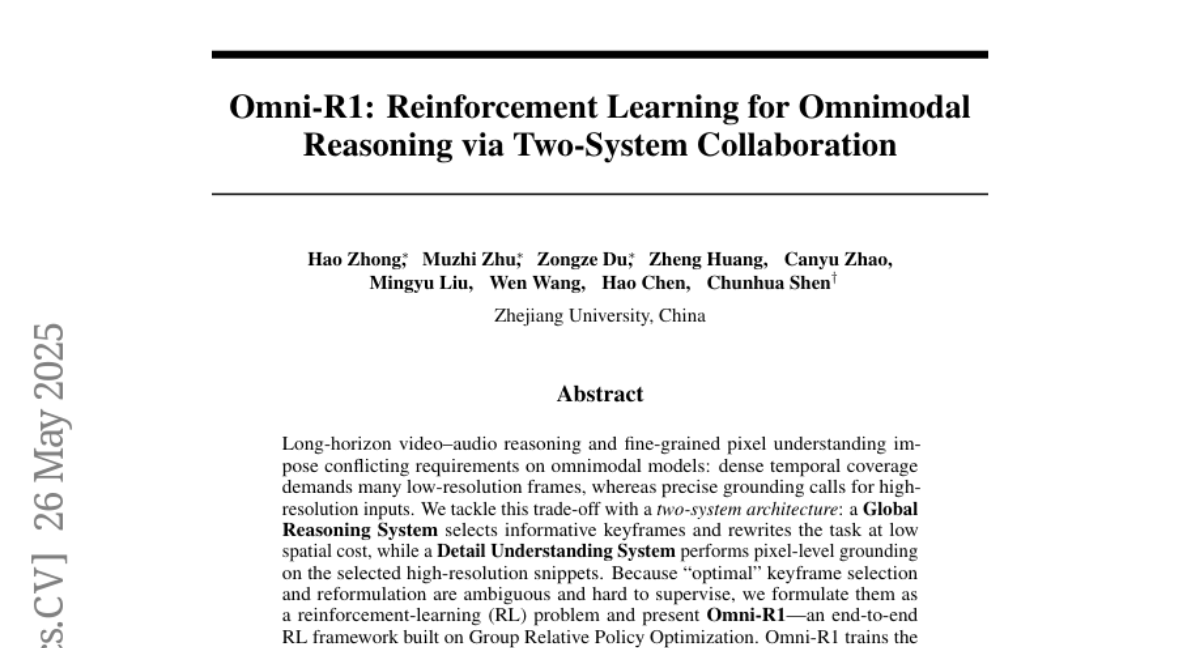
An end-to-end reinforcement learning framework, Omni-R1, achieves superior performance in long-horizon video-audio reasoning and fine-grained pixel understanding tasks by combining global reasoning and detail understanding systems.