OpenHelix: A Short Survey, Empirical Analysis, and Open-Source Dual-System VLA Model for Robotic Manipulation
Can Cui, Pengxiang Ding, Wenxuan Song, Shuanghao Bai, Xinyang Tong, Zirui Ge, Runze Suo, Wanqi Zhou, Yang Liu, Bofang Jia, Han Zhao, Siteng Huang, Donglin Wang
2025-05-08
Summary
This paper talks about OpenHelix, which is a new open-source model and study focused on helping robots use advanced AI systems to better control their movements and actions in the real world.
What's the problem?
The problem is that making robots smart enough to handle complex tasks, like picking up objects or moving around safely, requires special AI systems that can both understand their environment and plan actions. There are different ways to design these systems, but it's not always clear which designs work best or how to improve them.
What's the solution?
The researchers looked at and compared different dual-system VLA (Vision-Language-Action) architectures, which are setups where robots use both vision and language skills to make decisions. They tested the main parts of these systems and then shared their own open-source model, OpenHelix, so others can study and improve it.
Why it matters?
This matters because having better AI models for robotic control can make robots more useful and reliable in real life, whether it's for helping in homes, hospitals, or factories. By making their research open and easy to build on, the authors help speed up progress in making smarter, more capable robots.
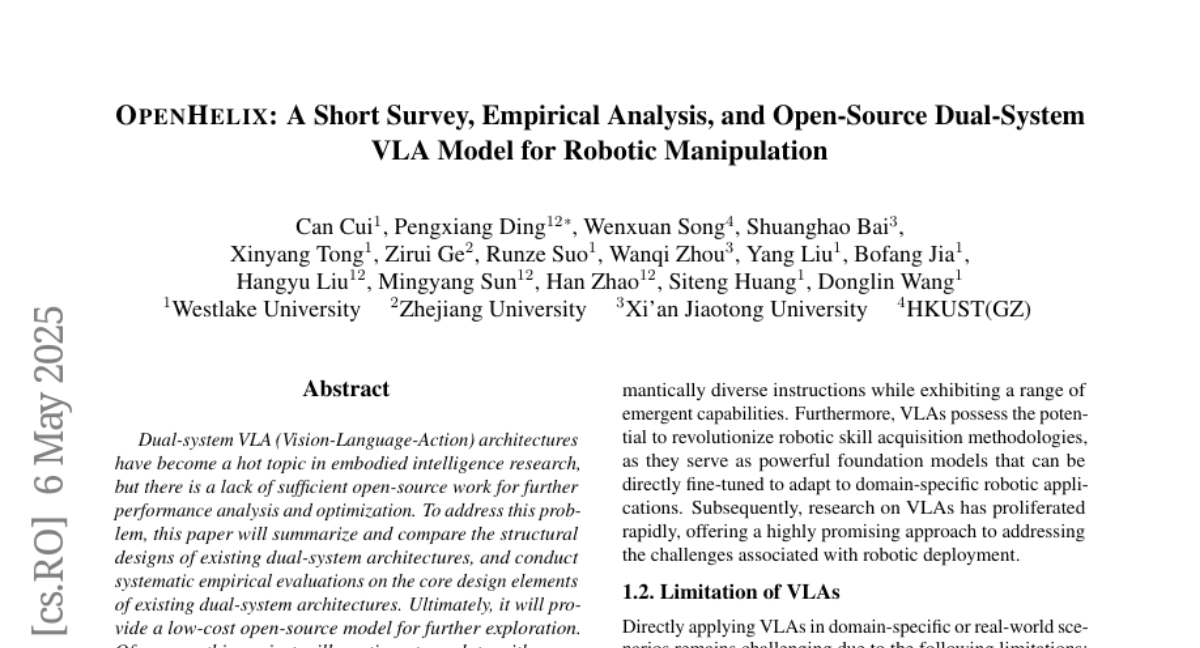
Abstract
The paper summarizes and compares dual-system VLA architectures, evaluates their core design elements, and provides an open-source model for further exploration in embodied intelligence.