OpenVision: A Fully-Open, Cost-Effective Family of Advanced Vision Encoders for Multimodal Learning
Xianhang Li, Yanqing Liu, Haoqin Tu, Hongru Zhu, Cihang Xie
2025-05-08
Summary
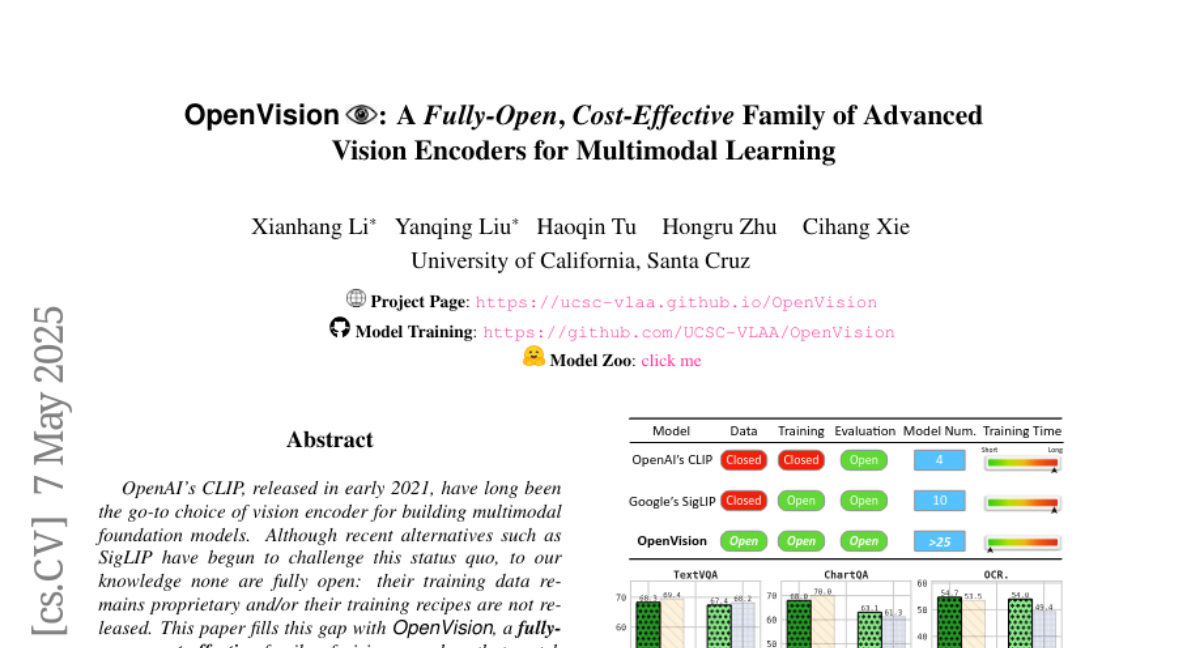
This paper talks about OpenVision, which is a new set of computer vision tools that are open for everyone to use and are designed to work well with both images and text, making them great for multimodal learning.
What's the problem?
The problem is that many of the best vision encoders, like OpenAI's CLIP, are not fully open or can be expensive to use, which limits who can access and improve them. There's also a need for models that can balance between being powerful and being efficient, depending on what people need.
What's the solution?
The researchers created OpenVision, a family of vision encoders that anyone can use for free. These models are designed to be flexible, so people can choose versions that are smaller and faster or bigger and more accurate, depending on their needs. OpenVision performs as well as or even better than the popular CLIP model in many situations.
Why it matters?
This matters because it gives students, researchers, and companies more options for building AI that can understand both images and text together. By being open and cost-effective, OpenVision helps make advanced technology available to more people, which can speed up progress and innovation in fields like education, science, and business.
Abstract
OpenVision provides a fully-open, cost-effective family of vision encoders that matches or surpasses OpenAI's CLIP in multimodal frameworks, offering flexible trade-offs between model size and performance.