Optimized Minimal 3D Gaussian Splatting
Joo Chan Lee, Jong Hwan Ko, Eunbyung Park
2025-03-25
Summary
This paper is about making 3D graphics faster and take up less space on your computer by optimizing how they are represented.
What's the problem?
Creating detailed 3D scenes requires a lot of storage and memory, which can make them slow to render, especially with 3D Gaussian Splatting.
What's the solution?
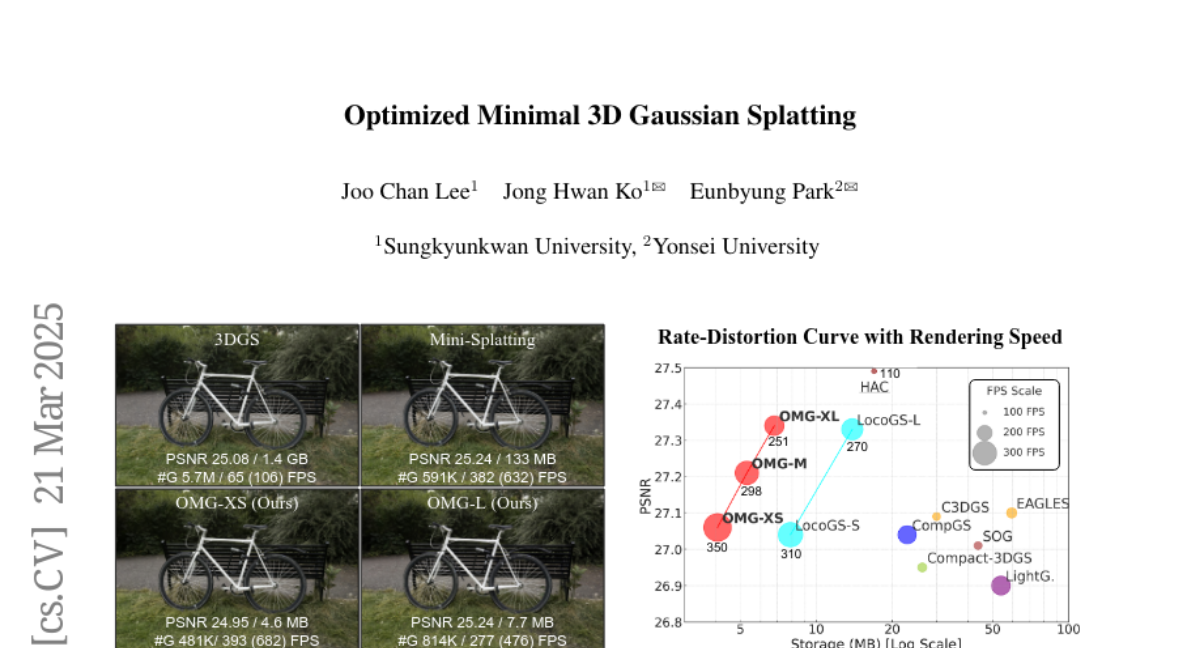
The researchers developed a new method called Optimized Minimal Gaussians (OMG) that reduces the number of data points needed to represent a 3D scene without sacrificing quality. It also makes these data points more compact and efficient.
Why it matters?
This work matters because it allows for faster and more efficient rendering of 3D scenes, making it possible to create more detailed and realistic graphics on a wider range of devices.
Abstract
3D Gaussian Splatting (3DGS) has emerged as a powerful representation for real-time, high-performance rendering, enabling a wide range of applications. However, representing 3D scenes with numerous explicit Gaussian primitives imposes significant storage and memory overhead. Recent studies have shown that high-quality rendering can be achieved with a substantially reduced number of Gaussians when represented with high-precision attributes. Nevertheless, existing 3DGS compression methods still rely on a relatively large number of Gaussians, focusing primarily on attribute compression. This is because a smaller set of Gaussians becomes increasingly sensitive to lossy attribute compression, leading to severe quality degradation. Since the number of Gaussians is directly tied to computational costs, it is essential to reduce the number of Gaussians effectively rather than only optimizing storage. In this paper, we propose Optimized Minimal Gaussians representation (OMG), which significantly reduces storage while using a minimal number of primitives. First, we determine the distinct Gaussian from the near ones, minimizing redundancy without sacrificing quality. Second, we propose a compact and precise attribute representation that efficiently captures both continuity and irregularity among primitives. Additionally, we propose a sub-vector quantization technique for improved irregularity representation, maintaining fast training with a negligible codebook size. Extensive experiments demonstrate that OMG reduces storage requirements by nearly 50% compared to the previous state-of-the-art and enables 600+ FPS rendering while maintaining high rendering quality. Our source code is available at https://maincold2.github.io/omg/.