OThink-MR1: Stimulating multimodal generalized reasoning capabilities via dynamic reinforcement learning
Zhiyuan Liu, Yuting Zhang, Feng Liu, Changwang Zhang, Ying Sun, Jun Wang
2025-03-31
Summary
This paper is about making AI that can understand and reason across different types of information (like images and text) better by using a more advanced learning method.
What's the problem?
AI models that can understand different types of data often struggle to reason in a general way, and the way they are trained can limit their abilities.
What's the solution?
The researchers created a new AI model called OThink-MR1 that uses a special type of reinforcement learning to improve its reasoning skills across different tasks.
Why it matters?
This work matters because it can lead to AI systems that are better at understanding and responding to the world around them in a more human-like way.
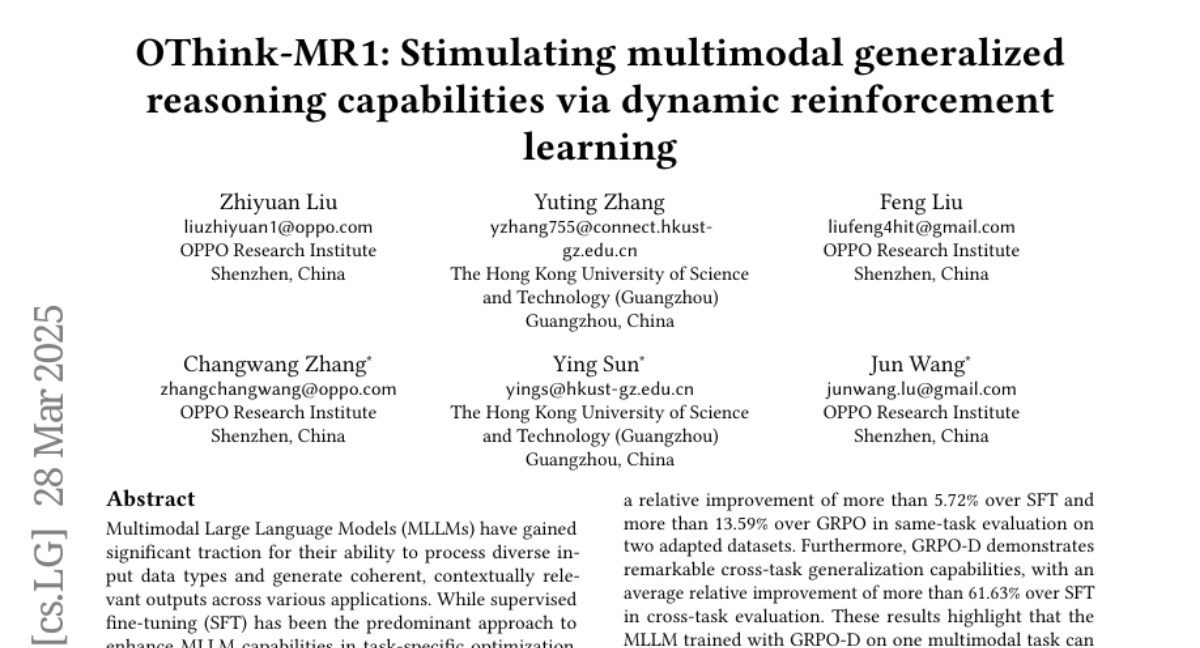
Abstract
Multimodal Large Language Models (MLLMs) have gained significant traction for their ability to process diverse input data types and generate coherent, contextually relevant outputs across various applications. While supervised fine-tuning (SFT) has been the predominant approach to enhance MLLM capabilities in task-specific optimization, it often falls short in fostering crucial generalized reasoning abilities. Although reinforcement learning (RL) holds great promise in overcoming these limitations, it encounters two significant challenges: (1) its generalized capacities in multimodal tasks remain largely unexplored, and (2) its training constraints, including the constant Kullback-Leibler divergence or the clamp strategy, often result in suboptimal bottlenecks. To address these challenges, we propose OThink-MR1, an advanced MLLM equipped with profound comprehension and reasoning capabilities across multimodal tasks. Specifically, we introduce Group Relative Policy Optimization with a dynamic Kullback-Leibler strategy (GRPO-D), which markedly enhances reinforcement learning (RL) performance. For Qwen2-VL-2B-Instruct, GRPO-D achieves a relative improvement of more than 5.72% over SFT and more than 13.59% over GRPO in same-task evaluation on two adapted datasets. Furthermore, GRPO-D demonstrates remarkable cross-task generalization capabilities, with an average relative improvement of more than 61.63% over SFT in cross-task evaluation. These results highlight that the MLLM trained with GRPO-D on one multimodal task can be effectively transferred to another task, underscoring the superior generalized reasoning capabilities of our proposed OThink-MR1 model.