Parallel Scaling Law for Language Models
Mouxiang Chen, Binyuan Hui, Zeyu Cui, Jiaxi Yang, Dayiheng Liu, Jianling Sun, Junyang Lin, Zhongxin Liu
2025-05-16
Summary
This paper talks about a new method called Parallel Scaling (ParScale) that makes language models run faster and use less memory by doing several calculations at the same time and reusing parts of the model.
What's the problem?
The problem is that as language models get bigger to become smarter, they also become slower and need a lot more memory, which makes them harder to use on regular computers or in real-time situations.
What's the solution?
The researchers introduced ParScale, which changes the way the model works so it can process information in parallel, meaning at the same time, and also reuses existing parts instead of adding more and more new ones. This makes the model much more efficient, reducing both the time it takes to get answers and the amount of memory needed.
Why it matters?
This matters because it allows powerful language models to be used more widely, even on devices with less memory or in situations where speed is important, like chatbots or phone apps.
Abstract
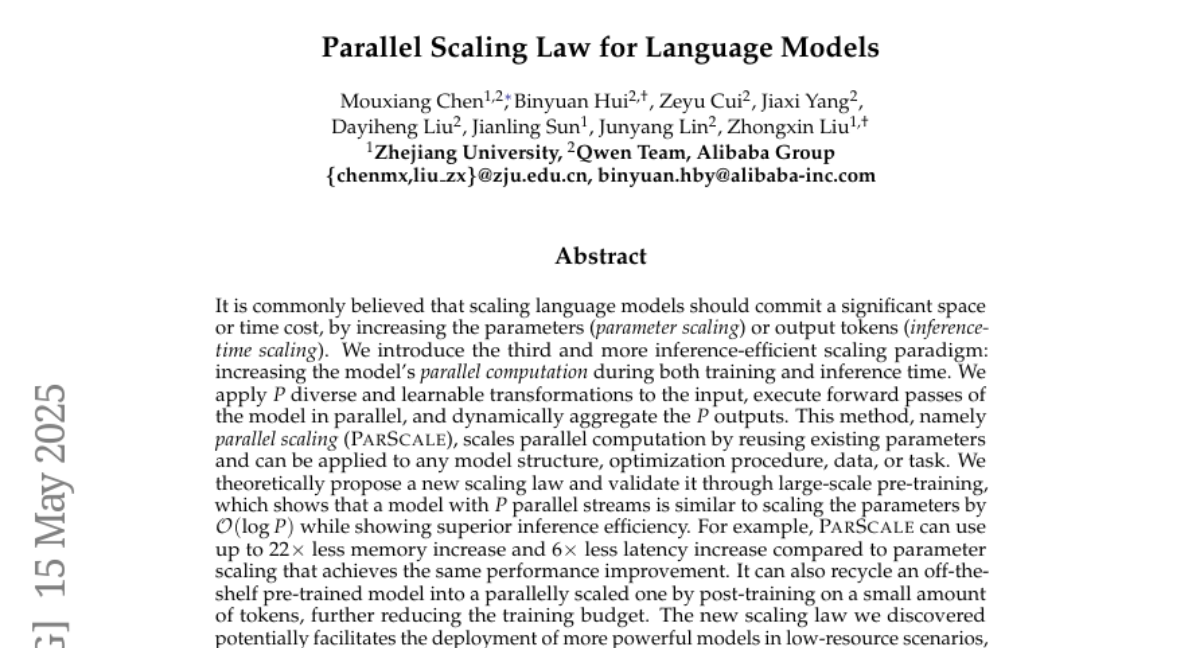
Parallel scaling (ParScale) improves inference efficiency by reusing existing parameters and executing multiple transformations in parallel, offering superior performance with reduced memory and latency compared to parameter scaling.