PAVE: Patching and Adapting Video Large Language Models
Zhuoming Liu, Yiquan Li, Khoi Duc Nguyen, Yiwu Zhong, Yin Li
2025-04-01
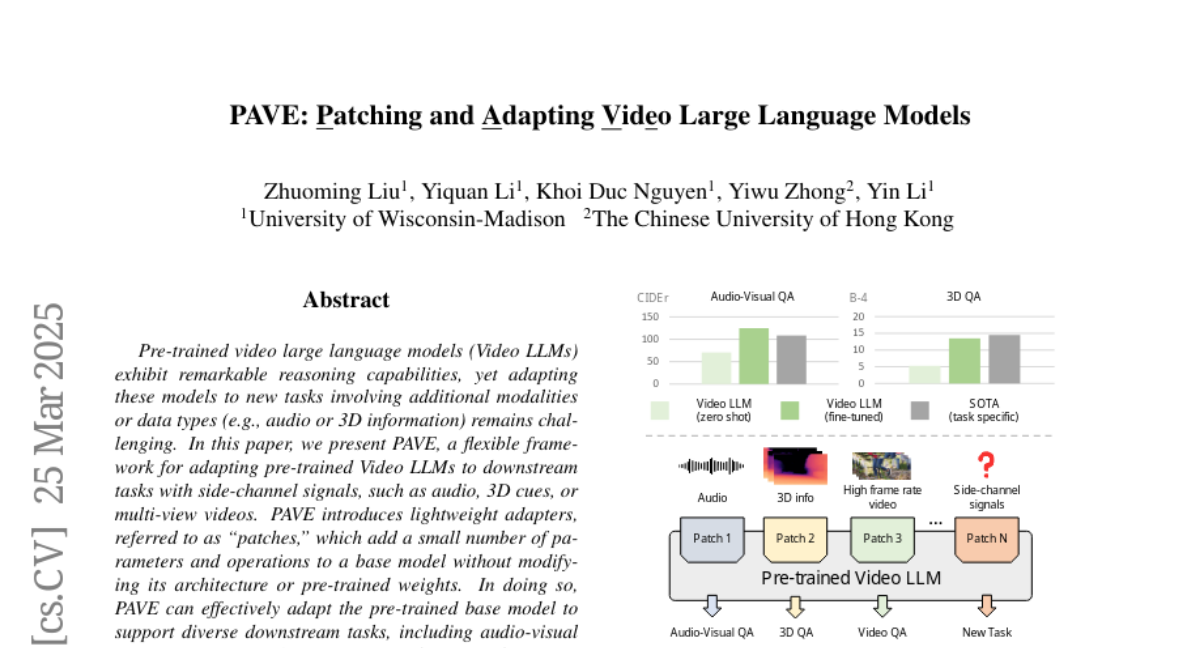
Summary
This paper is about a new method that makes it easier to teach AI models that understand videos to learn new skills or understand different types of information, like sound or 3D.
What's the problem?
It's hard to adapt existing video AI models to new tasks or data without changing the entire model.
What's the solution?
The researchers created PAVE, which adds small 'patches' to the AI model, allowing it to learn new things without requiring major changes to the original model.
Why it matters?
This work matters because it can make video AI models more flexible and easier to use for different applications.
Abstract
Pre-trained video large language models (Video LLMs) exhibit remarkable reasoning capabilities, yet adapting these models to new tasks involving additional modalities or data types (e.g., audio or 3D information) remains challenging. In this paper, we present PAVE, a flexible framework for adapting pre-trained Video LLMs to downstream tasks with side-channel signals, such as audio, 3D cues, or multi-view videos. PAVE introduces lightweight adapters, referred to as "patches," which add a small number of parameters and operations to a base model without modifying its architecture or pre-trained weights. In doing so, PAVE can effectively adapt the pre-trained base model to support diverse downstream tasks, including audio-visual question answering, 3D reasoning, multi-view video recognition, and high frame rate video understanding. Across these tasks, PAVE significantly enhances the performance of the base model, surpassing state-of-the-art task-specific models while incurring a minor cost of ~0.1% additional FLOPs and parameters. Further, PAVE supports multi-task learning and generalizes well across different Video LLMs. Our code is available at https://github.com/dragonlzm/PAVE.