Phi-4-Mini-Reasoning: Exploring the Limits of Small Reasoning Language Models in Math
Haoran Xu, Baolin Peng, Hany Awadalla, Dongdong Chen, Yen-Chun Chen, Mei Gao, Young Jin Kim, Yunsheng Li, Liliang Ren, Yelong Shen, Shuohang Wang, Weijian Xu, Jianfeng Gao, Weizhu Chen
2025-05-01
Summary
This paper talks about Phi-4-Mini-Reasoning, a small AI model that was trained to get better at solving math problems by learning to explain its thinking step by step.
What's the problem?
Small language models usually have trouble with tough reasoning tasks, like complicated math questions, because they don't have enough training or guidance to figure out the right answers.
What's the solution?
The researchers used a special training method that gave the model lots of high-quality examples where each step of the solution is shown clearly, helping the AI learn how to reason through problems more effectively.
Why it matters?
This matters because it shows that even small AI models can become good at solving hard math problems if they're trained the right way, making powerful tools available to more people without needing huge computers.
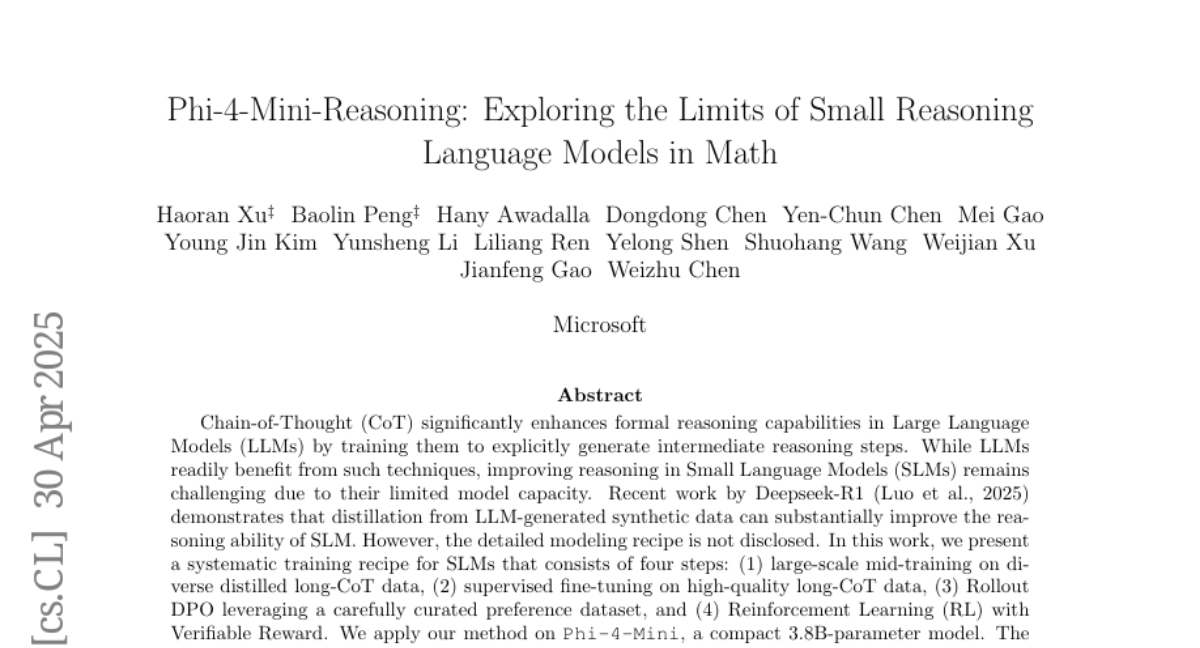
Abstract
A structured training method with high-quality Chain-of-Thought data improves reasoning abilities in small language models.