Physics-Assisted and Topology-Informed Deep Learning for Weather Prediction
Jiaqi Zheng, Qing Ling, Yerong Feng
2025-05-13
Summary
This paper talks about PASSAT, a new AI model for weather prediction that combines deep learning with real physics equations and a special way of representing the Earth's shape to better understand how weather works around the globe.
What's the problem?
The problem is that predicting the weather is extremely complicated because the Earth's atmosphere moves in complex ways, and traditional models can struggle to capture all the details, especially when it comes to how air and weather systems move over the curved surface of the planet.
What's the solution?
The researchers built PASSAT by including important physics equations, like the advection and Navier-Stokes equations, directly into the AI's learning process. They also used a spherical graph neural network, which helps the model understand how weather patterns interact on the round surface of the Earth, making the predictions more accurate.
Why it matters?
This matters because better weather prediction can help people prepare for storms, plan events, and even save lives by giving more accurate warnings about dangerous weather conditions.
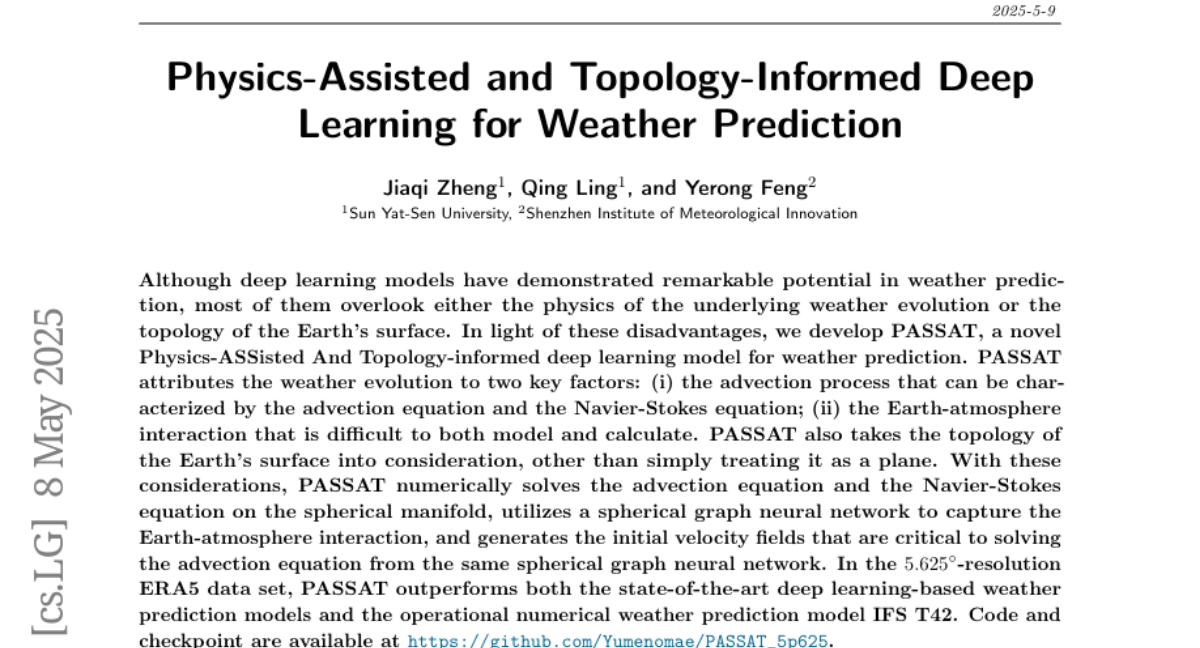
Abstract
PASSAT, a physics-assisted and topology-informed deep learning model, enhances weather prediction by integrating the advection equation, Navier-Stokes equation, and a spherical graph neural network to model Earth-atmosphere interactions on a spherical manifold.