"PhyWorldBench": A Comprehensive Evaluation of Physical Realism in Text-to-Video Models
Jing Gu, Xian Liu, Yu Zeng, Ashwin Nagarajan, Fangrui Zhu, Daniel Hong, Yue Fan, Qianqi Yan, Kaiwen Zhou, Ming-Yu Liu, Xin Eric Wang
2025-07-22
Summary
This paper talks about PhyWorldBench, a new benchmark designed to test how well text-to-video models follow the rules of physics when creating videos from written prompts.
What's the problem?
The problem is that while video generation models can create realistic-looking videos, they often fail to show believable physical behaviors like correct motion or energy transfer, which makes the videos less realistic and reliable.
What's the solution?
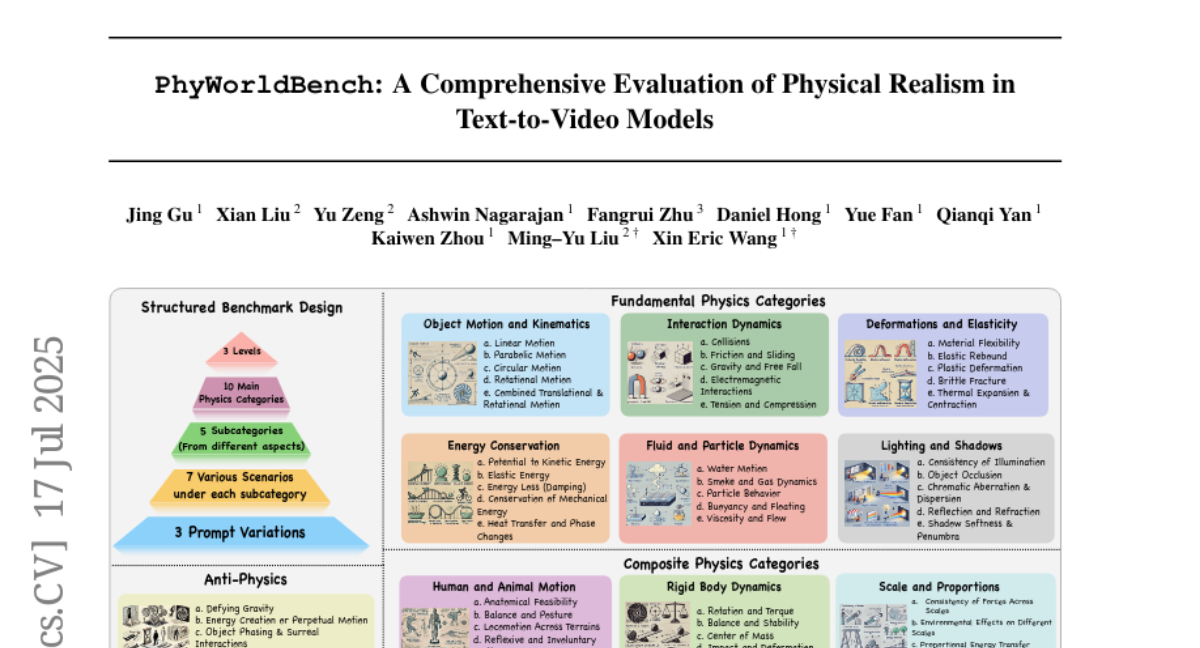
The authors created PhyWorldBench with over 1,000 carefully designed videos and prompts that test different physical concepts, including some prompts that intentionally break physics to see if models can still stay logical. They also developed an automatic way to measure how physically realistic generated videos are.
Why it matters?
This matters because it helps improve video generation technology by ensuring that AI models produce videos that not only look good but also make sense according to real-world physics, which is important for applications in education, entertainment, and science.
Abstract
PhyWorldBench evaluates video generation models' adherence to physical laws through a comprehensive benchmark, including an "Anti-Physics" category, and provides recommendations for improving physical realism.