Pitfalls of Rule- and Model-based Verifiers -- A Case Study on Mathematical Reasoning
Yuzhen Huang, Weihao Zeng, Xingshan Zeng, Qi Zhu, Junxian He
2025-05-29
Summary
This paper talks about a study that looks at how well computers can check if math solutions are correct, using either strict rules or AI models as verifiers. It explores whether these methods are actually reliable when computers are learning through rewards based on their answers.
What's the problem?
The problem is that both rule-based and AI-based systems, which are supposed to check if math problems are solved correctly, can make mistakes or be tricked. This is especially concerning when these verifiers are used to train other AI systems, because if the checker isn't accurate, the AI might learn the wrong things.
What's the solution?
The researchers tested these verifiers on various math problems to see where they fail and what their weaknesses are. By carefully studying their performance, they were able to point out specific situations where the verifiers either missed errors or accepted wrong answers, showing that these systems aren't as foolproof as people might hope.
Why it matters?
This is important because it shows that we can't always trust computer systems to check math work perfectly, especially when they're used to train other AI. Understanding these weaknesses helps researchers improve the tools, making future AI systems more accurate and trustworthy in solving and checking math problems.
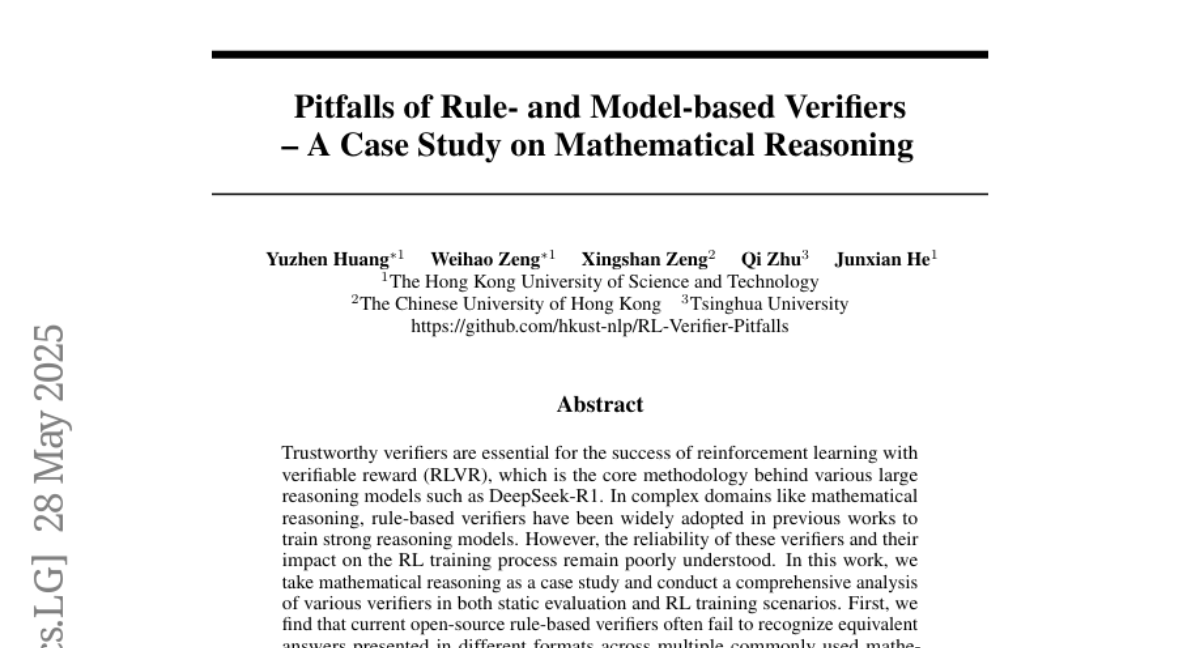
Abstract
The study examines the effectiveness and reliability of rule-based and model-based verifiers in reinforcement learning with verifiable reward, highlighting limitations and vulnerabilities in their use for mathematical reasoning tasks.